Getting Started
The Beat You Were Already Following: A First Evening of Body Percussion
Before buying a drum, try a quiet pulse and one changing pattern. A few minutes with your hands can reveal why a song moves—and where you want to join it.
By Hobby-ist Editorial Team · 5 min read · October 21, 2026
In this story
Sometimes your hand has found the song before you have thought about it. A finger taps the arm of a chair, or your foot marks a small repeated motion. Nothing is being performed for anyone. Yet there is already a relationship between the music and your body. You can begin a musical hobby there, without first choosing an instrument or deciding whether you are “a rhythmic person.”
Body percussion turns a few comfortable movements into sounds and silences: a soft thigh tap, a clap, fingertips meeting a palm. For this first evening, the aim is not speed or a complicated routine. It is hearing what stays steady while another part changes. That distinction is useful when you later play guitar, sing with someone or simply notice why one passage of a song feels different from the next.
A pulse is a place to return to
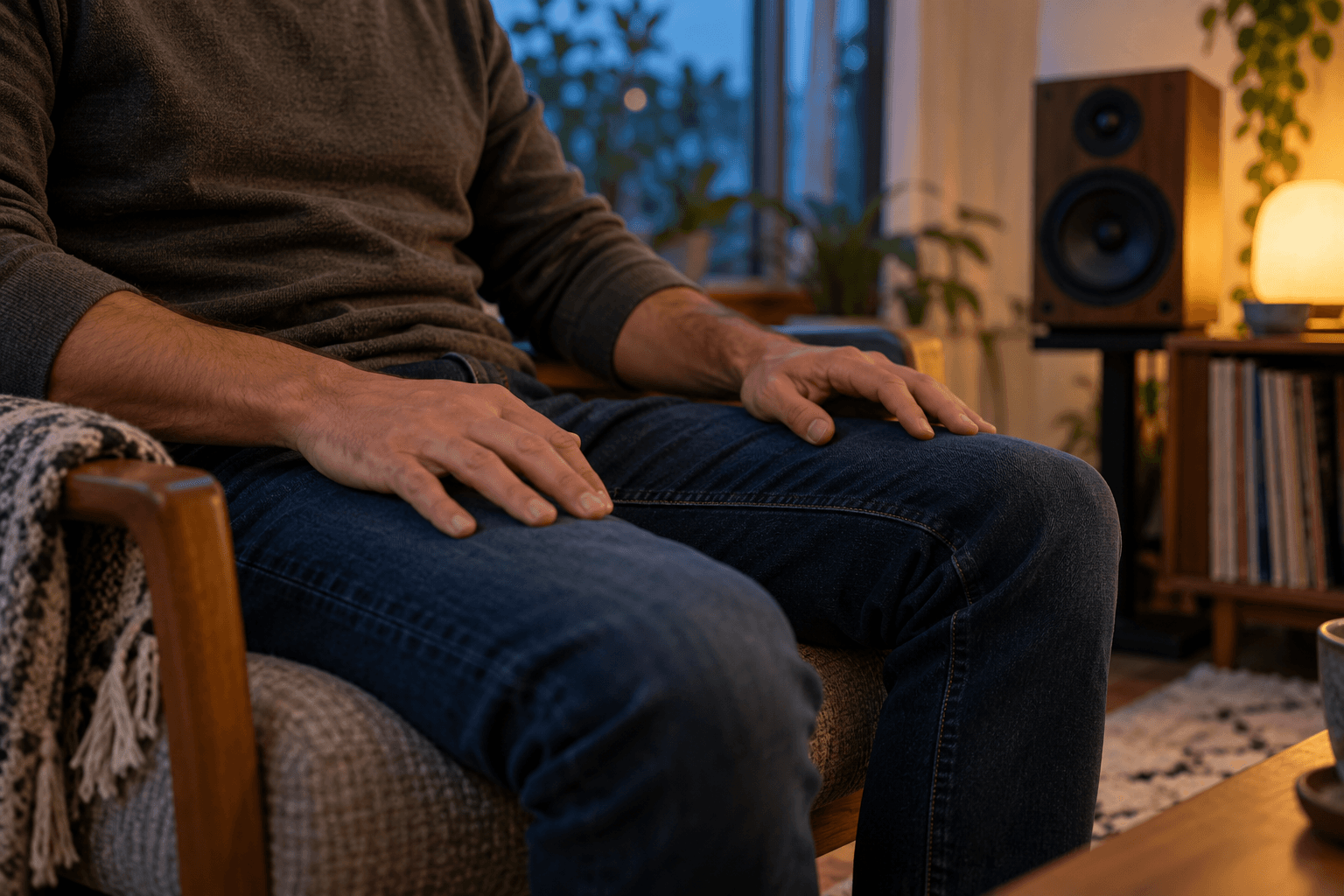
Begin seated comfortably, without a recording. Say “one, two, three, four” evenly and repeat. Tap one hand gently on your thigh with each number. Choose a speed at which you can speak without hurrying. The steady sequence is your pulse. A rhythm is an arrangement of sounds and spaces against that underlying flow.
This explanation is a starting model, not a claim that every piece of music has a simple four-beat structure. We are choosing a small, regular setting so there is something stable to hear. If you begin with a recording whose accents or tempo are hard to follow, the difficulty may belong to the choice of music rather than to your ability to learn.
Keep the touch light. You need not strike your body hard to produce an audible result, and the sound need not be equally loud every time. If a movement is uncomfortable, substitute a finger tap on a suitable soft surface or speak the sound instead. The relationship in time is the activity; a particular impact or pose is not the entry requirement.
Put one different sound into eight counts
Try eight steady spoken counts. On counts one, two, three and four, tap a thigh. On five and six, make two gentle claps. On seven, tap again. On eight, leave a silence while continuing the count. Then begin again at one. In short: tap, tap, tap, tap, clap, clap, tap, rest.
This is our practice pattern, not a traditional rhythm being presented without context. It is deliberately plain enough that the silence has a clear place. If clapping and counting together feels tangled, speak the whole sequence first, then add the hand movement. If eight counts feel long, repeat tap, tap, clap, rest over four counts until that becomes comfortable.
The rest is the revealing part. You are not waiting for the music to stop; you are allowing one place to pass without a hand sound. Count through it. If you begin again early, return to the spoken pulse and let the next round arrive in its own time. Silence is not empty space you have to rush across.
Change one thing and hear what it does
Once you can repeat the pattern without chasing it, keep the counts in the same places and make only the claps a little softer. Then restore them and make the last tap softer instead. You have changed the emphasis without changing where the sounds occur. That is different from adding another sound between the counts.
For a second variation, leave the volume comfortable and move one clap: tap on five, clap on six and seven, rest on eight. Compare it with the original before trying a third pattern. A small change is easier to hear when the surrounding material stays familiar. You are beginning to make choices, rather than merely trying to keep up with a sequence.
If you want to put a sound halfway between two counts, say “one-and-two-and” slowly first. The “and” divides the interval; it does not ask you to make the main count arrive sooner. This can wait for another evening. A first session can be complete after the eight-count pattern and its silence make sense.
A partner can make listening the interesting part
With someone else, let one person keep a quiet, even tap while the other plays the four-count version. Then swap. Agree on the pace before starting and use a clear spoken count-in. Choose a short round so both people know when it ends. A shared ending makes it easier to listen instead of wondering how long you have to continue.
The person keeping time is doing real musical work. It is tempting to give that role extra decoration because the other part sounds more interesting. Stay with it for one round and notice how much easier the pattern is to hear against something steady. Then take your turn. The exchange is more valuable than deciding which role is harder.
If you drift apart, stop together and count in again. Increasing the volume usually does not fix two different speeds. Nor does repeating the whole exercise faster. Try fewer movements at a comfortable tempo, keeping the same agreed endpoint. This is a useful way to collaborate without turning a small musical evening into a correction session.
Let a recording be company, not an exam
Choose a song you enjoy with a beat you can follow readily. Listen once before joining. Find a quiet tap that fits, and keep it simple enough to hear the recording. The first task is to stay with the pulse; you need not force our eight-count exercise over every section or imitate every drum sound.
If the arrangement changes and you lose your place, pause and listen. Rejoining on a clear beat is a musical choice. You have not ruined a performance. The same willingness to hear before doing appears in our first harmonica evening. For a different kind of patient attention, writing an ordinary letter also begins with something you already carry rather than a new purchase.
For demonstrated body-percussion activities, Carnegie Hall’s Rhythm Training School offers free teaching videos in its Musical Explorers resources. The materials are designed for children, but an adult beginner can still use the clear demonstrations to see an idea in motion. Watch the movement and listen to its timing rather than treating a printed description as a substitute for sound.
We recommend this beginning to someone curious about playing with music but undecided about an instrument. It will not replace instruction for a particular percussion tradition or instrument. What it offers is smaller and immediately available: a steady place, a changing sound and a silence you can choose to leave. The next time your hand finds a song, you may hear more clearly what it was following.
Sources & verification
Information checked: 2026-10-21