Perspectives
The Puzzle Can Stay Unfinished Tonight
A half-built picture on the table can be an invitation to return. Choose a puzzle for the evenings you actually have, and give it a place to wait.
By Hobby-ist Editorial Team · 4 min read · October 15, 2026
In this story
There is a particular pleasure in finding the piece with the missing sliver of a window. A small gap closes. The picture makes a little more sense. Nothing needs to be uploaded, scored or explained. You can enjoy the fit and then look for another one.
A jigsaw puzzle offers that kind of evening, but it can also become a surprisingly bossy object. It occupies the table, scatters into containers and seems to ask why you have not finished it yet. The difference often begins before the box opens: whether you choose for the time and space you have, or for the impressive finished picture you imagine.
Choose the picture you want to spend time inside
Piece count is an incomplete measure of difficulty. Ravensburger’s guide to puzzle difficulty points to image complexity, color variation and cut style as additional factors. A small puzzle full of nearly identical sky can demand more patient searching than its size suggests.
For a first quiet project, our preference is a picture with areas you can describe: the red doorway, the row of books, the bright flowers. Those sections give you something to choose when you sit down for a short session. A beautiful monochrome landscape may be a better second purchase once you know whether you enjoy long stretches of subtle comparison.
Look at the completed dimensions on the box as well. Measure the actual surface, including room for loose pieces. The dinner table is not available for a week just because a product photograph makes the puzzle look charming on one.
Give the unfinished picture somewhere to wait
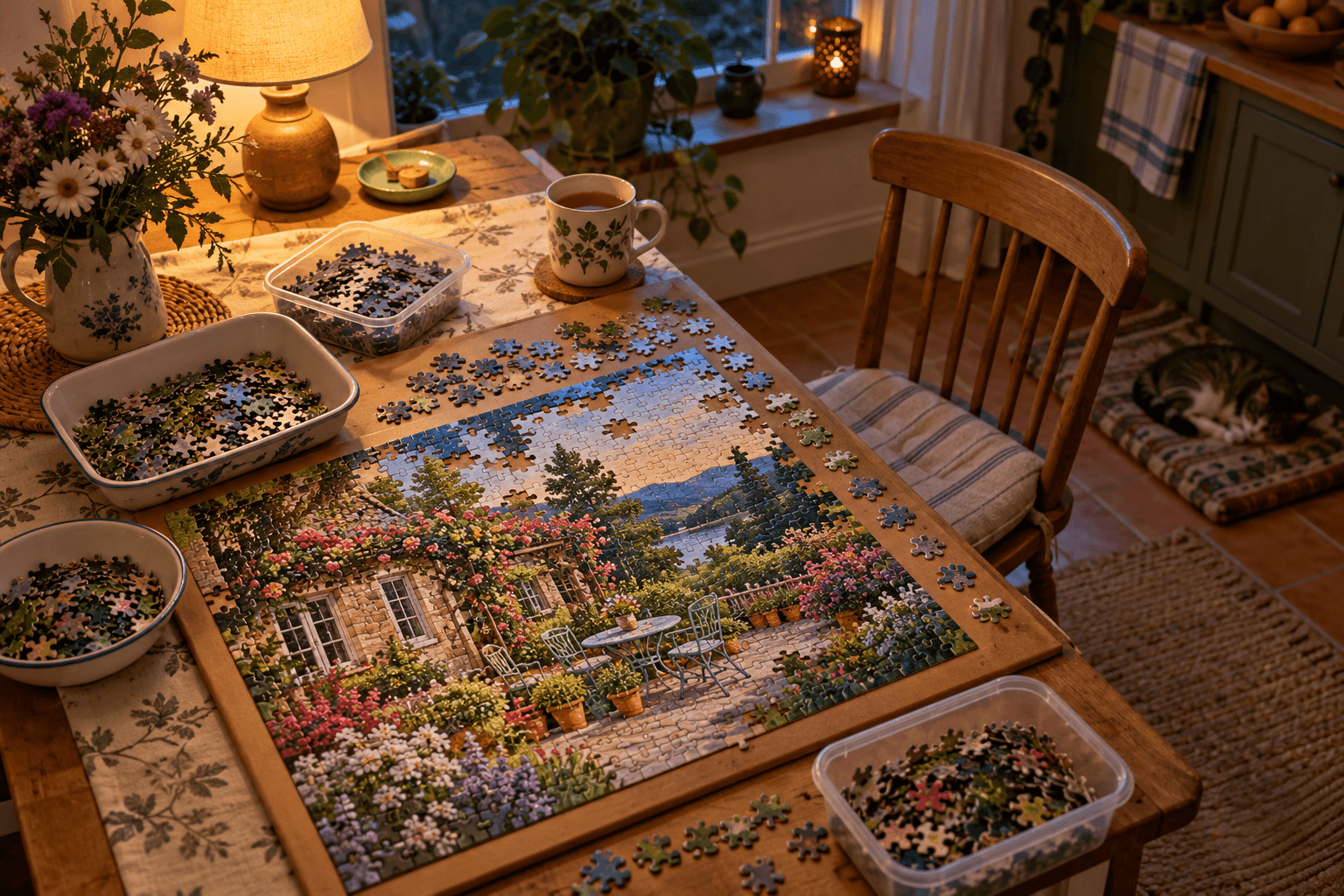
Before pouring out the bag, decide how the project will pause. A flat rigid board that fits the finished dimensions can make a shared table workable if you have somewhere safe to store it. Move the board level and test the arrangement before trusting it with a large assembled section. Keep pieces away from small children and pets, and separate the work from food and drinks.
You do not need an elaborate sorting system. A few clean shallow containers can hold broad groups. Leave yourself enough information to restart without remembering what each pile meant. A note such as “flowers near left window” is more useful than relying on the feeling that it was obvious at midnight.
This practical pause is part of the hobby, not an administrative chore after it. Our shared-home hobby space journal makes the same case for projects that need to coexist with daily life. A hobby is easier to return to when putting it away does not feel like erasing it.
Begin with something you can recognize
You can build the border first, or start with a distinctive object if that is what catches your eye. Neither order earns extra credit. Turn pieces face up, choose a manageable group and look at the reference image when you want help. There is no virtue in avoiding the box picture if it makes the evening less enjoyable.
When a piece appears to fit, check the image and its neighbors rather than forcing the cardboard. If an area stops making sense, set it aside. Moving to a different section is a decision, not a failure of concentration. You can leave one troublesome patch for a night when you want a different sort of task.
Two people do not have to work at the same pace
With a partner, try choosing separate areas and sharing useful finds. Ask before completing the little section the other person has been building. The pleasure of a final fit can be surprisingly personal; taking over in the name of helping may remove the very part they were enjoying.
Some people love the clock, and speed puzzling has its own community and competitive format. That is a legitimate direction if comparison adds enjoyment. For this evening, though, our suggestion is to stop at a place you can recognize tomorrow rather than at a number of minutes or pieces.
Let a small gap remain
Before stopping, take a moment to notice what appeared: a roofline, a hand, the first edge of a garden. You have changed a pile into part of a picture. That is enough to make the session real, even with most of the box still loose.
If you like another small exercise in choosing what to notice, try our six-photo journal on a walk. Both activities become more interesting when attention has somewhere specific to go.
Leave the next piece for tomorrow if you want. An unfinished puzzle can be a promise small enough to keep.
Sources & verification
Information checked: 2026-10-15