Getting Started
Six Photos, One Choice: Learning to See What You Want to Keep
Taking another photo is easy; choosing one tells you something about your eye. Compare a small group, separate a picture’s purpose from its sharpness and find a useful next shot.
By Hobby-ist Editorial Team · 4 min read · October 8, 2026
In this story
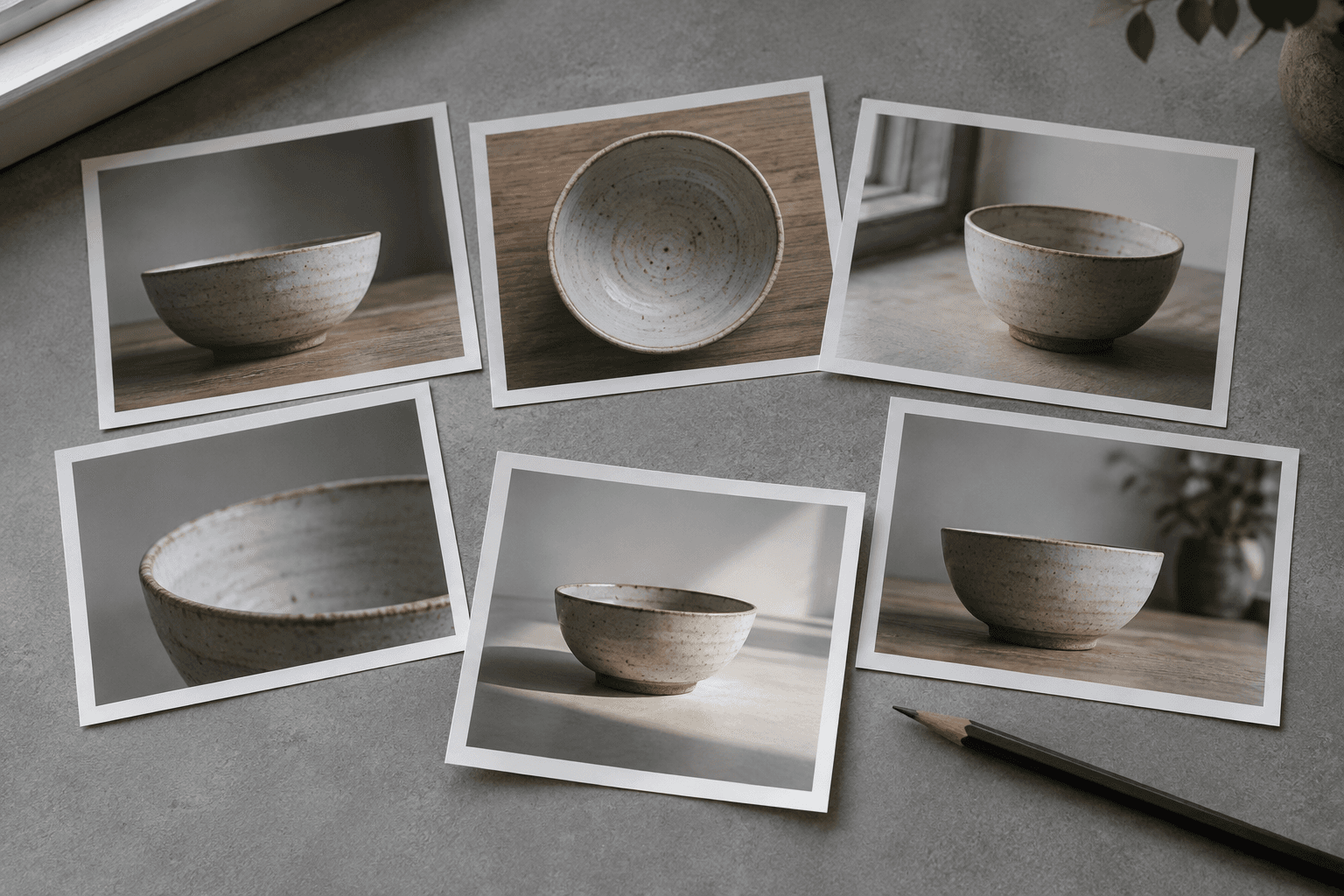
You photograph a bowl near a window. Then again from a little higher, once with more table around it and once close enough to lose the rim. Six pictures later, taking another feels easier than choosing one.
It is a familiar point in a small creative project. The act of making gives you something to do; deciding asks what you actually meant. That pause is useful. Choosing photographs can teach you about your own attention without requiring a new camera or a more impressive subject.
Start with a group small enough to see together. The aim is not to crown your greatest photograph. It is to leave with a choice you can explain—and one idea you would like to try next.
Give the photograph a job
Before comparing, finish a sentence: “This picture is for…” A clear record of a handmade bowl, a memory of breakfast and an atmospheric image for a journal are different jobs. A tight detail might beautifully show a glaze while failing to explain the bowl’s overall shape. A wider frame might keep the morning’s context while making the object less prominent.
Without a purpose, you can keep changing the rules until every image disappoints you. For a useful first session, pick one purpose. You can keep a second favorite for a different reason later; it does not invalidate the first choice.
Put six images in the same conversation
Use an existing gallery’s grid or a simple arrangement of prints. Look at the group before opening individual images. A contact sheet does this by placing pictures together. Adobe’s Bridge documentation describes a PDF grid with customizable rows and columns. You do not need to install or buy software for this exercise; the useful idea is simultaneous comparison.
Keep the display size reasonably consistent. If one image fills the screen while another remains a tiny thumbnail, you are comparing presentation as well as photographs. At this stage, notice where your eye goes first and whether that matches the job you named.
Separate unusable from less preferred
A missed point of focus, an obstructed subject or a cut-off feature may prevent a picture from doing its particular job. That is different from disliking an angle. Check a finalist at a larger view for technical problems, but avoid inspecting every pixel of all six before you have noticed their ideas.
An image with movement might still be a meaningful memory. It may be a poor choice for showing stitch detail in a product photograph. The same flaw can matter differently in different contexts. If the result you wanted is technically missing, our indoor phone-photo blur guide can help you separate causes before the next attempt.
Mark candidates or copy them into a separate selection rather than deleting the originals. The first pass is a decision for today, not a permanent judgment on every image you made.
Describe what changes between the last two
Suppose one frame includes the window shadow and another fills the frame with the bowl. “I like the first one” is a start. “The shadow makes this feel like a morning, while the closer frame shows the shape clearly” tells you much more. Now your choice is connected to the purpose rather than an unexplained ranking.
Look at edges as well as the center. Does a partial object at the border pull attention away? Is the space around the subject helping the mood or simply accidental? These are questions to consider, not universal composition rules. Our window-light exercise gives you another way to explore how the same object can tell different stories.
Take one lesson back to the camera
Your next action should be specific enough to try. “Improve composition” is too broad. “Leave a little more space above the rim” or “include the shadow because it carries the morning feeling” gives you a decision you can make while shooting.
You do not have to reshoot immediately. Save the thought beside the selected image or remember it for next time. Editing your attention is a result too. A session that ends with one understood choice can be more satisfying than another hundred pictures you never review.
Leave a place for the image you simply love
This method suits beginners overwhelmed by similar frames and makers choosing a clear image of their work. It is less useful when your immediate goal is to enjoy photographing freely without stopping to assess. Let those sessions exist as well.
Hobby-ist’s judgment: use purpose to make a selection, but do not require every personal photograph to justify itself. The technically strongest frame and your favorite memory can both stay. Choosing teaches you what matters; it does not have to shrink the things you are allowed to love.
Sources & verification
Information checked: 2026-10-08