Ideas
A Line You Can Hold: Spend an Evening with One Embroidered Leaf
A small hoop, one color of thread and a drawing simple enough to finish. Your first embroidery project can be an evening of noticing rather than a new supply collection.
By Hobby-ist Editorial Team · 4 min read · October 15, 2026
In this story
A pencil line can happen almost faster than you think. A line made from thread asks you to wait. It appears in short sections, with a needle passing through cloth between each one. Even a small leaf takes a little negotiation: where to turn, how far to go and when to stop pulling.
That slower line is a good reason to try embroidery before deciding whether you want a complicated pattern or a drawer of colors. For one evening, the project can be one outline on a scrap of cloth. The outcome is small enough to hold, and the process is visible enough to teach you something.
Draw less than you think you need
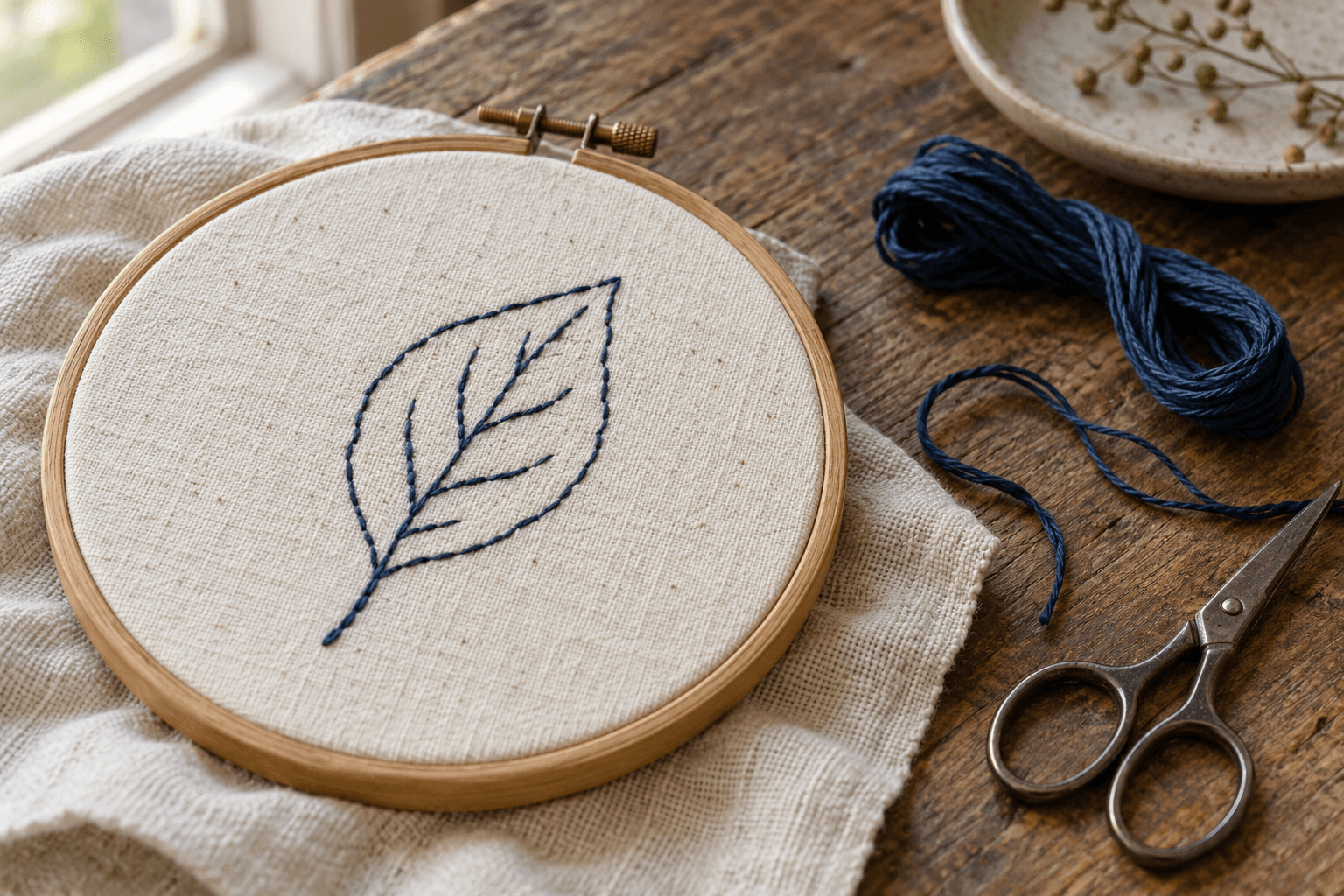
Our suggested first subject is a leaf with an outline and a single center line. Leave out the shading, tiny veins and perfectly symmetrical pairs. A simple drawing lets you see what the stitches are doing; an elaborate design can hide the actual lesson underneath too many decisions.
Use a piece of stable woven cotton large enough to sit securely in a small embroidery hoop, an embroidery needle suitable for the cloth, floss and scissors. Keep the needle in a pincushion or closed case between sessions. Before buying anything else, look at what you already have and check whether a basic kit covers the few missing items.
Choose one thread color that you enjoy against the fabric. A darker blue on cream, for example, makes the line easy to see without requiring you to make a color palette. Two strands of standard six-strand floss are a reasonable starting suggestion for this small practice drawing; try a short line on spare cloth before committing to the leaf. The exact result depends on thread and fabric.
Why backstitch suits this little drawing
DMC’s stitch tutorials demonstrate backstitch as a way to make a connected outline. In simple terms, each stitch meets the end of the previous one. Watch the demonstration before beginning if the needle’s direction is hard to picture from words.
Work a short straight sample first. Then try a shallow curve. Our advice is to shorten the stitches as the curve turns so that the outline does not become a series of large corners. You are not aiming for identical measurements everywhere; you are learning how a line changes when its direction changes.
DMC also warns that excessive tension can pucker the cloth. That is a more useful thing to watch than speed. Pull the thread until the stitch rests on the surface, then stop. If a small crease begins to gather, loosen the stitch before adding several more over it. It is easier to change one section while it is still easy to see.
Give the evening an ending
A sensible first session has three parts: a few practice stitches, the leaf outline and a final look outside the hoop. Those are suggestions, not a timed performance. If the outline is enough for one night, leave the center line for tomorrow. Finish or secure the working thread according to the technique you are following, put the needle away and store the work where it will stay clean.
Removing the hoop for a look matters because tension can disguise what the fabric is doing. Is the cloth fairly flat? Can you still recognize the leaf? Which curve looks the most like the mark you wanted? Choose one observation for the next attempt, rather than judging the entire piece as good or bad.
This is the same modest scale of practice we like in our first watercolor patches: a small piece of evidence about the material is already a result.
A finished object does not have to become a product
You might keep the leaf as a sample, sew it onto a future project once you know how, or place it inside a notebook. There is no need to promise a whole embroidered wardrobe. If the repetitive motion appeals to you, make a second leaf with slightly shorter stitches and compare the curves. If it does not, one small experiment has answered the question without much leftover equipment.
For people sharing a table, a hoop and a closed supply pouch can also be easier to move than a large ongoing setup. Our shared-home hobby space journal explores that everyday side of keeping a project welcome.
The leaf may not resemble the neat example you first imagined. But the line will have taken a route your hand can remember. That is a satisfying thing to make in an ordinary evening.
Sources & verification
Information checked: 2026-10-15