Getting Started
Starting Indoor Herbs: Seeds or Young Plants?
Choose the growing experience you want, then check the light and drainage you can provide. A practical first-herb decision before filling the windowsill.
By Hobby-ist Editorial Team · 6 min read · October 6, 2026
In this story
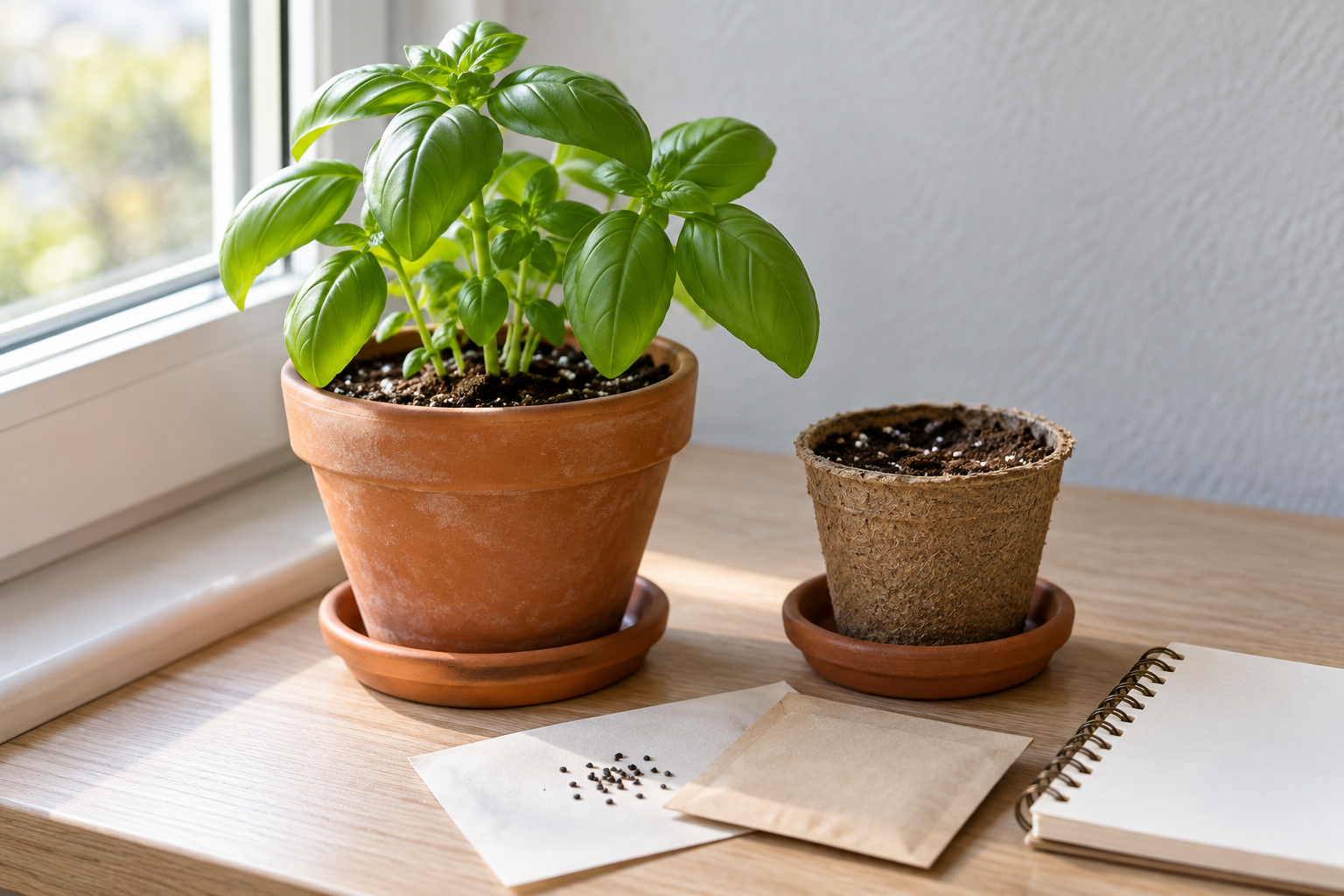
A seed packet and a small herb plant offer different first experiences. Seeds let you watch a plant begin. A young plant lets you start with something you can already inspect and care for. Neither turns an unsuitable windowsill into a productive garden.
Why we picked this decision: the first purchase should match the part of growing you want to learn. Hobby-ist's starting recommendation is one young culinary herb for learning a care routine, or one small seed sowing when watching germination is the main attraction. Check the growing space before choosing either.
Start with the window, not the packet
Indoor herbs need more than a room that looks bright to your eyes. Iowa State University's indoor-herb guidance identifies light as a frequent limiting factor. It recommends a sunny position and supplemental lighting when available light is insufficient.
Before shopping, note when direct sunlight actually reaches the proposed pot location on an ordinary day. Note nearby buildings, curtains, and the distance from the glass. Repeat on another day if the first is unusually cloudy. Our proposed observation is a screening step, not a light-meter measurement or proof of sufficient growing light.
In Los Angeles, a sunny forecast does not guarantee a sunny apartment window. If the spot receives little useful light and you do not want to provide suitable supplemental lighting, pause the indoor-herb plan. Buying a larger plant will not remove that constraint.
Check practical access too: can you reach the pot to inspect it, protect the surface from drainage, and keep it away from a heat vent? A narrow decorative shelf may be a poor growing place even when it photographs well.
Choose a young plant when care is the first lesson
A nursery-grown culinary herb suits a beginner who wants to practice checking moisture, observing new growth, and eventually taking modest amounts for cooking. You skip the germination stage and have leaves to inspect from the beginning.
The trade-off: you are paying for a plant that has already been grown, and you do not learn how it started. It also arrives with conditions to check. Look for a clearly identified edible herb, firm stems, healthy-looking leaves, and no obvious pests or damaged growth. Ask the seller about its current care and container needs.
Do not judge only by the biggest mass of leaves. Inspect the base and drainage, and ask whether the container holds several crowded plants. A full supermarket pot and a young nursery plant may have different next steps. A plant's attractive appearance at purchase does not establish how well it will grow in your home.
Our suggested first purchase is one herb you already use, not a mixed collection. If you dislike basil in food, a basil plant is not automatically the right starter because it appears in many tutorials.
Choose seeds when the waiting is part of the hobby
Seeds suit someone who enjoys checking small changes and does not need a harvest for a particular meal. A packet can provide more than one attempt, but not every seed becomes a usable plant. A small sowing is easier to accommodate than a tray full of seedlings with nowhere to go.
Read the packet before buying: variety, sowing depth, germination conditions, expected emergence window, spacing, and eventual size. Seed-starting mix, containers, and adequate growing light belong in the decision too. Comparing only a packet's price with a finished plant leaves out the rest of the setup.
The trade-off: the early stage gives you more to observe but also more conditions to manage. Germination and usable leaf growth are separate milestones. Do not treat the packet's germination estimate as a harvest date, or assume a seedling that emerged can thrive with insufficient light.
Write down what you sowed and when. If it has not emerged within the packet's expected window, check its instructions and growing conditions before replacing everything. Avoid adding more water simply because you cannot yet see growth.
The herb matters as much as the starting method
Basil is a useful example because both seed and young-plant routes are available, but it still needs appropriate growing conditions. Our editorial reason for using it as an example is that the comparison can stay within one herb. It is not a claim that basil is the easiest choice for every apartment.
Cilantro introduces a different consideration. The University of Maryland's herb-seed guidance lists cilantro among herbs that do not transplant well and recommends direct sowing for garden culture. For a container beginner considering it, ask about sowing into the intended growing pot rather than moving seedlings repeatedly. Follow the chosen variety's container and spacing instructions.
Keep the first experiment to one species. Different herbs can need different moisture management. Iowa State recommends separate containers for different species; a mixed decorative planter makes it harder to adjust care for just one plant.
A perennial herb is also not a promise of an endless indoor supply. Select for the conditions you can offer and the herb you want to use, rather than assuming all plants sold as “herbs” share one care routine.
Make the container part of the choice
Maryland's container-herb guidance emphasizes well-drained containers and a suitable lightweight growing mix. A decorative outer pot is not a substitute for drainage in the growing container. Use an arrangement that lets you check and remove drained water without wetting the furniture.
For a young plant, confirm whether its current pot can be used initially and what size is appropriate when repotting. For seeds, use the packet's sowing instructions and allow for thinning and later growth. Avoid selecting a huge container just to postpone every future decision.
Moisture needs differ between germinating seeds and established plants, and between herb species. Follow the relevant instructions and inspect the growing mix. “Water every Tuesday” is a reminder to check, not a universal rule to water.
Put the whole setup into your hobby cost plan: the plant or seeds, growing mix, drainage arrangement, and any lighting you actually need. The cheaper starting item is not necessarily the cheaper workable setup.
Use the first week to observe rather than harvest
Our proposed first-week checklist is deliberately small:
- At setup: record the species and variety, starting method, pot, location, and care instructions. Take a reference photo for yourself.
- During checks: note the growing mix's moisture, drainage, and visible changes. Make a care decision from the plant's instructions rather than the calendar alone.
- At the end of the week: review what you could reliably observe. A seed may still be within its stated emergence window. A purchased plant may be adjusting rather than ready for repeated harvests.
A week is our planning interval, not a growth benchmark. Keep the focus on understanding the setup. If growth is weak, investigate conditions before adding more varieties. If the instructions or plant condition are unclear, a nursery question or suitable introductory class may help; our guide to choosing beginner help offers a way to decide.
Once the plant is growing well, use species-specific harvesting guidance. A small indoor pot is best treated as a learning project with occasional fresh flavor, not a guaranteed replacement for all your grocery herbs.
Hobby-ist's final choice
Choose one young plant if you want to learn care with a visible starting point. Choose a small sowing if watching germination is what you want to do. If the growing place is unsuitable, solve that before buying either.
Our preference for many first-time growers is the young-plant route because it removes one stage from the initial task. The seed route is equally meaningful when that stage is the hobby itself. Success here is learning which conditions you can maintain, rather than filling every available windowsill.
Editorial status: Researched. This article combines university extension guidance with Hobby-ist's proposed decision framework and observation checklist. We did not conduct a growing trial or visit a nursery for this article. The cover is AI-generated and does not show measured growth, a tested setup, or an actual harvest.
Sources & verification
Information checked: 2026-10-06