Ideas
Crochet for Beginners: Choose Your First Fall Project
A coaster, a small pumpkin, or a simple decoration? Choose by the steps you want to learn, then give one project a place on your table.
By Hobby-ist Editorial Team · 5 min read · September 30, 2026
In this story
A tiny crocheted pumpkin can make starting look wonderfully simple. It fits in a palm. It takes only a little shelf space. Surely something so small cannot ask very much of you.
Then the instructions mention shaping, joining, stuffing and finishing, and the small object begins to feel like several projects at once. Size is only one part of choosing a first make. A useful beginner project lets you see what you are doing and understand what comes next.
If you already know you want to try crochet, here are three ways to choose a first fall project. This is a project-selection guide, not a tested pattern or a promise that any particular design can be finished in one evening.
Begin with the instructions behind the picture
Open the complete pattern before buying yarn. Read its materials, techniques and finishing sections, even if the stitch abbreviations are still unfamiliar. Look for explanations you can follow and photographs that show the awkward parts, not only the finished object.
The Craft Yarn Council’s project-level guidance distinguishes basic stitches from additional shaping, color work and more involved techniques. A beginner label is helpful, but your actual question is more personal: how many unfamiliar things will this pattern ask you to learn at once?
For a first attempt, our suggestion is to choose one main learning task. If you are practicing where to insert the hook, you may prefer a project that does not also require several color changes and tiny pieces to sew together.
A square coaster: practice you can keep
A simple coaster worked back and forth in one stitch gives you a clear reason to practice rows. Look specifically for a beginner pattern with a plain shape and explicit stitch counts. The word “coaster” alone is not a difficulty rating; decorative circular designs may involve much more.
The appeal is everyday usefulness. You can notice the piece again tomorrow without needing to make a matching set. Choose this route if you like the idea of watching a small area of fabric grow and would enjoy repeating a movement.
Before starting, check how the pattern handles the beginning and end of each row. After a row, pause to count as instructed. If the count changes unexpectedly, finding that moment is useful practice. Making four imperfect coasters is not a requirement for becoming someone who crochets; one practice square is a perfectly reasonable beginning.
A small pumpkin: choose the construction carefully
Choose a pumpkin if having a seasonal object in mind makes you eager to sit down. First check how it is constructed. Some patterns begin with a flat piece that is joined and gathered; others use rounds and shaping. The finished silhouettes may look similar while the instructions ask for different skills.
Read through the joining, filling and stem steps before deciding. A design with an elaborate leaf, separate tendrils and several finishing pieces may be better saved for later. You can also ask a teacher whether a simpler pattern would meet the same wish.
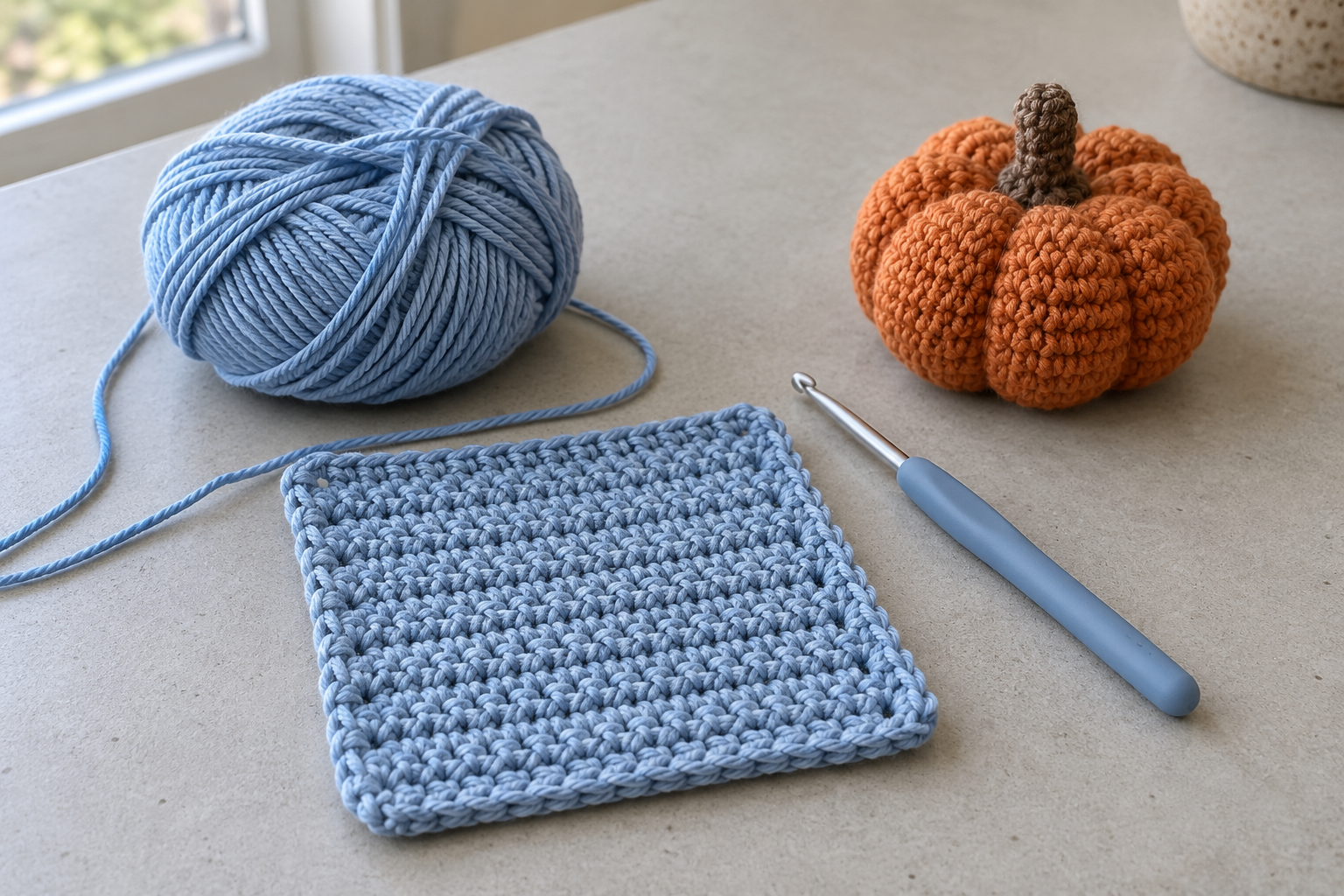
Treat the pumpkin as a decoration unless the pattern and materials are specifically appropriate for another purpose. And keep the finished photograph in perspective: our cover is an AI-generated illustration of the idea, not a photograph of a pattern we have made and tested.
A flat decoration: keep the first version simple
A small flat shape can be appealing if you want to hang one thing by your desk or add it to a gift. Read the pattern with the same care as any larger project. A tiny leaf with changing stitch heights and shaping is not automatically easier than a plain square.
Consider starting with a simple rectangular tag or another design with clear repeated rows. One color and one uncomplicated shape can give you a satisfying object while leaving room to learn the finishing step. Check how the ends are secured and how any hanging loop is attached.
Choose a single decoration before planning a whole garland. Repeating the project can be a second decision, made after you know whether you enjoyed the first one.
Match the supplies to the chosen pattern
Use the pattern’s specified yarn and hook information as your starting point. The Craft Yarn Council’s hook guide explains metric sizing and checking gauge when finished dimensions matter. A hook size alone cannot guarantee the same result with a different yarn.
For a learning piece, consider smooth yarn in a color that lets you distinguish the stitches. Before buying a bundle of tools, check the actual list: hook, yarn, scissors, a suitable yarn needle and any markers or filling the design calls for. Purchase for this project rather than for every possible future one.
Also check whether the pattern uses US or UK terminology. The same stitch name can mean different things: US single crochet corresponds to UK double crochet. Keep the Craft Yarn Council’s abbreviation guide beside the pattern instead of mixing instructions from different systems.
Give the first session a small, visible ending
If you have never held a hook, begin with the Craft Yarn Council’s single-crochet lesson, which includes an introductory practice block. You can learn the movement before asking it to become a seasonal object. If you are still deciding between crafts, our knitting-versus-crochet guide covers that earlier choice.
For tonight, choose a stopping point such as completing the foundation or working the first few rows according to your instructions. Leave a note with the pattern, hook size and place you stopped. The next session should begin with something you recognize.
The pumpkin can wait a little. What matters first is making a beginning that invites you back to the table.
Sources & verification
Information checked: 2026-09-29