Ideas
Start a Junk Journal With Three Scraps From Your Week
Turn three ordinary paper scraps and a short note into a page you want to revisit. A small journaling project for a week that did not feel particularly remarkable.
By Hobby-ist Editorial Team · 6 min read · September 27, 2026
In this story
Sometimes the week disappears without leaving much you would think to photograph. You went to work, bought something for dinner, walked the same block, and had a conversation you meant to remember. By Sunday, even the conversation has become difficult to reconstruct.
A paper journal can begin there. You do not need a holiday, a milestone, or a collection of beautiful supplies. You need a few things that make you pause and think: this was part of my week.
For this project, try one page, three scraps, and a short note. Give yourself about twenty minutes if that feels comfortable. The time and material limits are an invitation to begin, not a rule to follow perfectly.
What kind of journal are we making?
People use “junk journal” for a range of paper practices, including books assembled from reused materials and pages filled with found paper. Here, we are borrowing the simplest idea: give ordinary paper another job by turning it into a personal record.
You can work inside a notebook you already own. There is no binding project to complete first, and no requirement to make the page look vintage. Your page might be spare and graphic, crowded and colorful, or almost entirely handwriting.
Unlike a planner, it does not need to organize next week. Unlike a daily diary, it does not need to account for every day. Today’s page only has to keep one small part of this week from slipping away.
Gather a small, unprecious kit
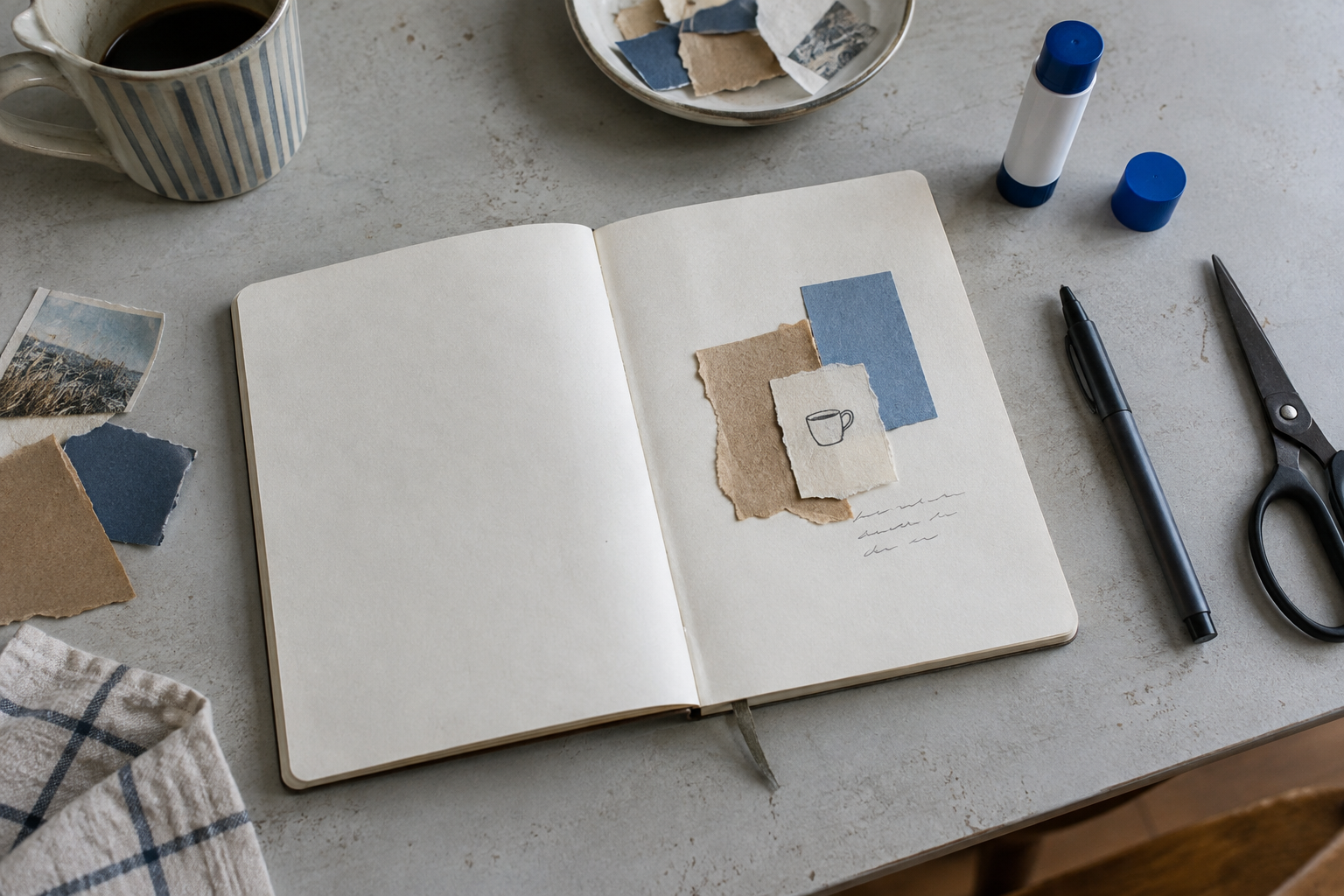
Set out a notebook or a sheet of paper, a pen, three lightweight paper pieces, and a glue stick suitable for paper. Scissors are optional; torn edges work too. Test unfamiliar glue on a spare scrap and follow the product’s directions.
Start with clean, dry materials you can comfortably cut or change. The inside of an envelope, plain packaging paper, a copy of a small photograph, or a scrap carrying your own drawing can all become part of the page. You do not need to purchase papers that imitate a life you already have.
Keep irreplaceable letters, photographs, and documents separate; work with copies instead. This quick project is not an archival preservation method. For a scrapbook intended to last, the Library of Congress recommends specific materials and attachment methods, including acid- and lignin-free paper and suitable photo corners. Its scrapbook care guide is a better starting point for preserving originals than an ordinary glue stick.
Choose three pieces that have different jobs
Emptying an entire drawer onto the table can turn a small activity into a sorting task. Look for three pieces with these roles instead.
- One reminder: a paper that points to something you did, saw, or talked about.
- One visual detail: a color, pattern, or texture you want to keep looking at.
- One place for words: a plain scrap on which to write what the other pieces cannot explain.
These roles can overlap. An envelope might supply both the blue pattern you like and the memory of a letter. If you only have two pieces, use two.
Imagine a page about taking the long way home. A piece of brown packaging can recall a stop for bread; a blue scrap can echo a door you noticed; a small handwritten note can hold the reason you walked more slowly. This is an example, not a record of an outing we took.
Nothing saved from the week? Draw the object you remember, copy a phrase from your own notes, or tear a shape that suggests the place. The page does not need a ticket to prove you were there.
Arrange first, attach second
Put the largest piece down first without gluing it. Place the second partly beside or over it, then find a home for the smallest piece. Leave room for a sentence and a date.
Try two arrangements. In one, keep everything close together. In the other, let the pieces spread across the page. Choose whichever makes your eye stop where you want it to stop. There is no need to audition twenty versions.
If the page feels busy, remove something before adding decoration. If it feels empty, write the note before deciding it needs another object. Blank paper can give a small detail room to matter.
Once you like the arrangement, attach the pieces with a light, even application appropriate to your adhesive. Let them dry as directed before closing the book. Avoid thick objects that force the notebook to bulge; one modest paper layer is plenty for a first page.
Write the part a photograph would miss
“Coffee, Tuesday” tells you what and when. “We stayed after the cups were empty because neither of us wanted to leave yet” tells you why you saved it.
Your sentence does not need to be poetic. Specific is more useful than polished. Start with one of these:
- I kept this because…
- The detail I almost missed was…
- I thought it would be an ordinary afternoon until…
- Next time, I want to remember to…
You can also write something unresolved: “I still don’t know why I liked this corner so much.” A journal is allowed to preserve a question.
Add a date or a loose time marker such as “the last week of September.” Then give the page a small title if one comes naturally. “The longer route” is enough. So is no title at all.
Stop before the page becomes homework
When the three pieces and your note are in place, take your hands off the page for a moment. Can you tell what you wanted to keep? If so, it may already be finished.
You do not have to photograph it for social media, match last week’s colors, or fill the facing page. A quiet page can belong in the same book as a crowded one. Missing several weeks does not create a backlog you owe the notebook.
Before sharing a page publicly, check for addresses, order numbers, barcodes, or other details on reused papers that you would prefer to keep private. A personal record does not automatically need to become public content.
Leave yourself an easy way back
Keep one envelope for possible scraps, rather than saving every piece of paper you encounter. When it starts to feel crowded, choose a few favorites and recycle what you do not want to keep. The envelope is a temporary collection, not another obligation.
Next time, change only the question. What made you laugh? What color followed you around? What did you do for the first time in a while?
Our one-color photo walk offers another way to notice ordinary details. You could use one of your own photographs from that walk on a future page, or leave the two activities separate.
The point is not to make every week look eventful. It is to notice that an uneventful week can still contain something you want to meet again.
Sources & verification
Information checked: 2026-09-27