Ideas
The One-Color Photo Walk: A Small Reason to Go Outside
Turn a familiar route into a small photography project. Choose one color, make a few deliberate pictures, and collect five you want to see again.
By Hobby-ist Editorial Team · 6 min read · September 24, 2026
In this story
You know the route well enough to stop seeing it. The corner you turn on the way to buy groceries. The wall beside the parking lot. The row of planters you pass without looking up.
For your next walk, give that familiar route a different job: help you find one color.
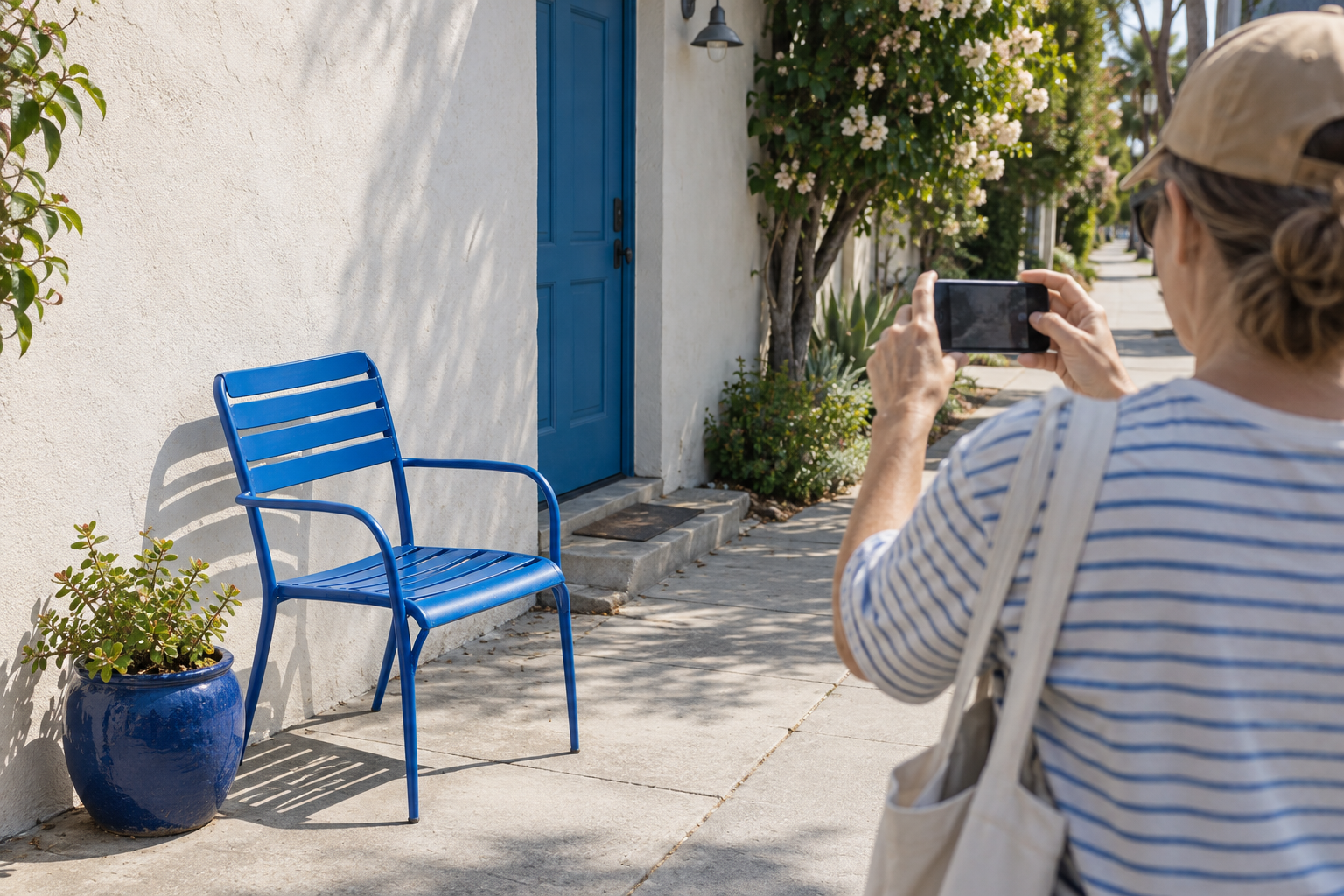
Blue might turn up in a chair, a painted gate, a piece of tile, and a shadow that looks different through your camera. None of those things needs to be remarkable on its own. Together, they can become a small record of what you noticed.
This is a simple photography exercise you can try without buying equipment or traveling somewhere photogenic. The aim is to make a handful of deliberate choices and see whether you enjoy making them.
Your first walk, in brief
- Bring: A charged phone with a camera. Use the ordinary camera app you already know.
- Choose: One color and a familiar, comfortable route.
- Allow: Around 20–30 minutes if that suits you, including pauses and your return.
- Make: Up to ten photographs, then choose five to keep together.
- Finish: Give the set a name and write one sentence about an image.
Those numbers are suggestions, not a score. A ten-minute outing with three pictures can work just as well. You can also do the exercise from a seated spot, around your home, or along an accessible route that works for you.
Choose a color that leaves room for surprise
Start with a broad color family. “Blue” gives you more possibilities than a very particular shade of turquoise. If you have already noticed several red details nearby, red may be an easier first assignment.
Once you have chosen, spend a moment looking without taking a picture. Where does the color appear? Is it a large surface or a tiny interruption? Does it belong to something permanent or something that will be gone tomorrow?
You can include variations. A faded blue door and a bright blue bucket need not match perfectly. Deciding how far to stretch the theme is part of the activity.
If color is not a comfortable way for you to organize what you see, choose a shape or texture instead: circles, stripes, cracked surfaces, or repeating lines. Keep the same simple rule throughout the outing.
Give your five pictures different jobs
Five photographs of similar doors may be exactly the collection you want. But if you would like a little variety, use these prompts as invitations.
The color that fills the frame
Find a surface where your chosen color does most of the work. Look at its texture and edges. Try framing it with less of the surrounding scene.
You do not have to move close to get the idea. Work from a position where you can comfortably and appropriately stand, and leave private spaces alone.
The small detail
Look for a little patch of your color surrounded by something quieter: a button on a public fixture, a tile in a pattern, or a leaf against a plain background.
Before taking the picture, ask what competes for attention. A small change in where you point the phone may make the detail easier to see.
The repetition
Find two or more related shapes. They might be chairs, pots, or painted marks. Notice whether you prefer a tidy rhythm or one element that breaks it.
The question is not whether the arrangement is perfect. It is which part of the arrangement made you stop.
The wider scene
Include enough of the surroundings to show where the color lives. This photograph can give the other, closer images a sense of place.
Try making a second version from the same spot with a different frame. Later, compare what you included and what you left out.
The surprise
Leave one place in your set open. It may be an unexpected reflection or a detail you only notice on the way back.
You do not need to find all five kinds. If the assignment starts to feel like paperwork, drop a prompt and follow the thing that interests you.
Stop walking before you start framing
It is easy to concentrate on the screen and forget the space around it. Pause somewhere clear of other people’s movement before taking your picture. Keep driveways, crossings, and entrances available to the people using them.
You can make the whole exercise about objects and surfaces. If you want a person to be the subject of a close photograph, ask first. Respect requests not to photograph and the rules of spaces you enter.
Avoid including identifying details you do not need, such as readable mail or a stranger’s private information. Before sharing a picture, look through the frame again rather than noticing only its main subject.
These choices are part of composing the image. A picture worth keeping can also be considerate of the place where you made it.
Turn the camera roll into a small collection
When you get home, choose five pictures without editing them first. Picking a set is a different task from taking individual photographs.
Begin with the image you remember most clearly. Then add one that changes the pace: a closer detail after a wide scene, a simple surface after a busy pattern. Put them in an order you like.
If two images do almost the same thing, compare their edges. Which includes the detail you care about? Which contains something distracting? Keep the one that better expresses what you noticed.
Give your set a plain name, such as “Blue on the way home.” Write a sentence under one picture: “I had passed this chair for months before noticing the chipped paint.”
You can keep the collection privately in an album or note. Posting it is optional. The exercise is complete when you have made something you want to look at again.
When the idea gets stuck
“There is nothing interesting near me.” Make the subject smaller. Try handles, corners, shadows, or the meeting point between two materials. You are looking for a detail, not a destination.
“My pictures do not look like what I saw.” Choose one image and describe the missing part. Was it the scale, the surrounding space, or the contrast between colors? On another day, try a different frame. You have found a question to explore.
“I took too many pictures.” Keep only the selection task: choose three. There is no need to sort your entire photo library to finish this one outing.
“I did not enjoy photographing anything.” Notice whether you liked the walk or the searching more. You might prefer a walk with a notebook, or simply looking without recording. That is useful information too.
Leave a small reason to return
For a second outing, change one element. Keep the route and choose another color, or keep the color and try a different familiar route. Comparing two small collections gives you something specific to notice.
If you go with a friend, choose the same theme and make your selections separately. Compare what caught each person’s eye without turning the number of photographs into a competition.
The guide to finding a hobby you’ll enjoy offers another way to decide what deserves a second try.
You may finish with a photograph you like. You may also finish with the discovery that an ordinary block contains more than you usually give it time to show you. Either is a good reason to take another look.
This is an independent activity guide from hobby-ist. The timing, picture prompts, and selection exercise are editorial suggestions, not a formal course or a promise of particular results.
Sources & verification
Information checked: 2026-09-24