Getting Started
Knitting vs. Crochet: Which Should You Try First?
Turn a saved picture into something you try with your own hands. Compare the tools, choose a small first exercise, and find a way into yarn crafts without buying a whole new hobby at once.
By Hobby-ist Editorial Team · 6 min read · September 27, 2026
In this story
Perhaps there is a knitted scarf in your saved photos. Or a small bag, a colorful square, a little object you can imagine on your desk. You have thought about making something like it. Then you open a beginner tutorial and encounter your first decision: two needles or one hook?
“Which is easier?” seems like the obvious question. Another question may be more useful: what do you want to make, and what would you enjoy practicing?
You do not need to choose a lifelong craft before touching a ball of yarn. You need a way to begin this week. A small practice piece can tell you more about that choice than another evening of comparing finished projects.
Start with one thing you want to make
Look at three pictures you have saved. Are you drawn to clothing, accessories, or small decorative pieces? Choose one and check whether its description identifies knitting or crochet.
If a particular project is what brought you here, learning its technique gives you a direction. Do check the actual instructions: both crafts can produce clothing and smaller objects, so the object’s name alone will not tell you how it was made.
If you have no particular project in mind, consider which kind of help is available. A beginner class where you can ask questions, or a tutorial you find easy to follow, is a perfectly good reason to start with one technique. Having somewhere to return when you get stuck matters.
What is the difference between knitting and crochet?
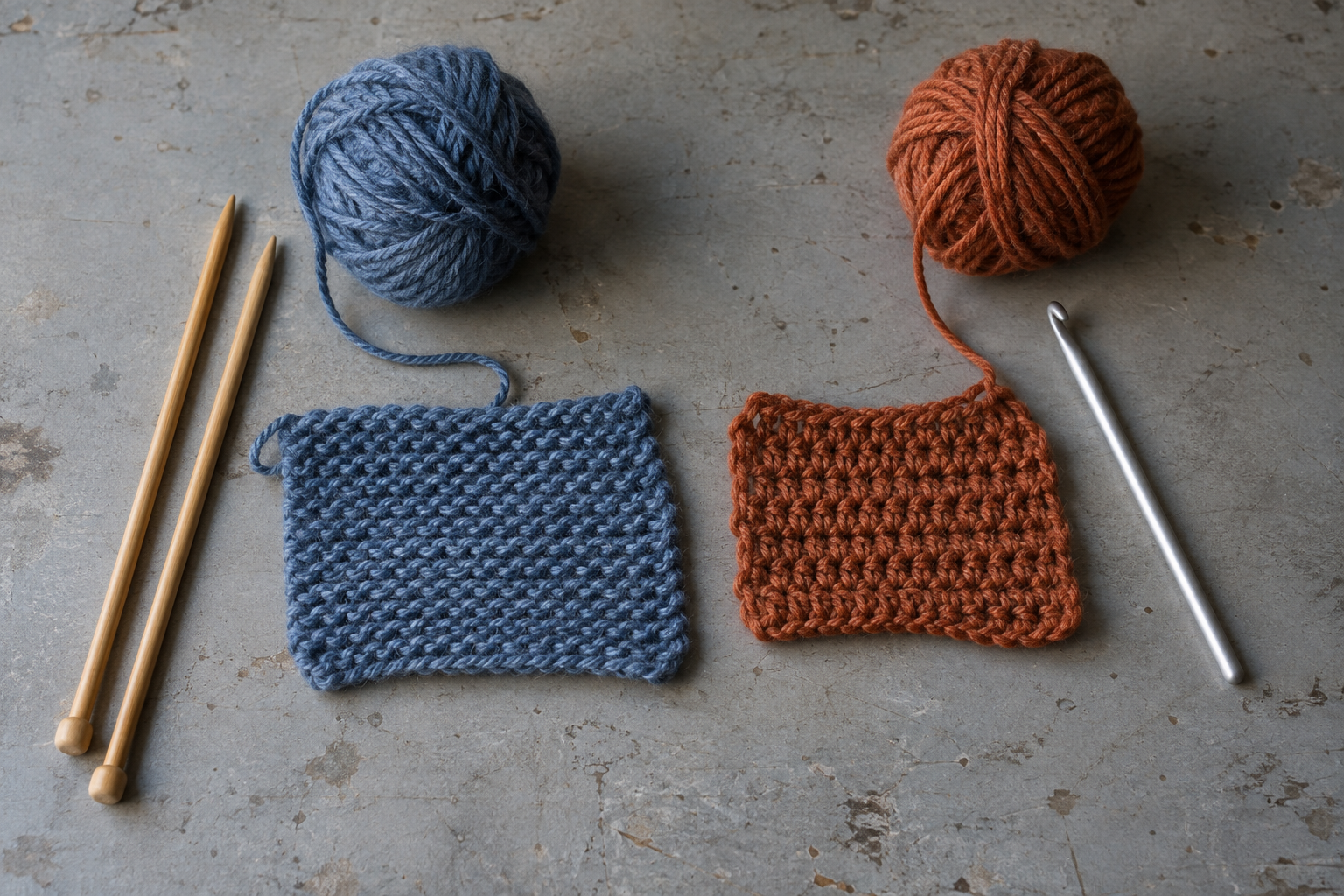
Knitting uses two needle tips to work stitches. Casting on and learning the knit stitch are common first steps. Crochet uses a hooked tool to draw yarn through loops; the chain is a common starting technique. The Craft Yarn Council’s comparison introduces these tools and basic methods.
For your first choice, consider three practical differences in the experience you are about to try:
- The movement you want to learn. Watch how two knitting needles move together, then how a crochet hook draws yarn through a loop. Which explanation can you follow? Both crafts involve learning what each hand does.
- The exercise in front of you. A knitting lesson might begin with casting on and repeating one stitch. A crochet lesson might begin with a chain and a simple stitch. Follow the sequence in the lesson you choose rather than combining several unrelated instructions.
- The support around it. Can you see the instructor’s hands? Can you pause and replay the awkward part? Can you ask a question? A fast transformation video is not necessarily an effective first lesson.
Starting with one does not close the door on the other. Your first choice is permission to experiment, not a declaration of identity.
Separate “easy” into three questions
Understanding a movement, recognizing a mistake, and wanting to keep going are different experiences. A technique can feel clear when you watch it and surprisingly awkward when you try it. Another can take longer to understand but make you curious enough to return.
After watching a short beginner demonstration, ask: Can I see where the tool goes next? Does the teacher explain the part I missed? Would I like to try that movement a few more times?
Being slow on the first day is not evidence that you chose badly. Your eyes and hands are learning a sequence together. Equally, a craft that looks easy may not hold your interest if you cannot imagine anything you want to do with it.
After your first session, judge the experience before judging your ability. Were you waiting for it to end? Or did you want to pause, make a drink, and try one more row?
Buy for one exercise, not an imagined future collection
Choose a beginner lesson before choosing a large kit. Match its supply list: yarn, the appropriate needles or hook, and scissors. Check whether it also calls for a yarn needle for finishing or stitch markers. If you book a class, ask what it provides before buying duplicates.
Read the yarn label as well as choosing a color. A yarn’s thickness category is different from the weight of the ball. In the Craft Yarn Council system, categories run from 0 to 7, from finer to thicker yarn. Labeling varies, so use its label guide alongside the requirements of your chosen instructions.
The suggested tool size is a starting point. For a project that must fit a specified size, check the pattern’s gauge: the number of stitches and rows within a stated measurement. The CYC yarn-weight guide likewise treats its tool ranges as general guidance rather than a substitute for a pattern’s requirements.
For practice, our suggestion is to choose yarn whose stitches you can see clearly. Tell the shop assistant, “I’m learning, and I want something that makes the stitches easy to identify.” The most exciting yarn in a photograph may not be the most helpful yarn for today’s exercise.
Let the first session produce a small piece of evidence
Set aside about half an hour and open one beginner lesson. That is a suggested window for trying, not a promise that you will finish anything. Spending it learning to cast on or make a chain still counts as starting.
If you can move on, aim for a little rectangular practice piece. It does not need to become a gift or something worth posting. Its job is to make the movement visible: here are a few rows that did not exist before you sat down.
When you stop, keep the yarn label with your tools and leave yourself one specific note. “I understood the chain, but got confused starting the next row” is more useful than “bad at crochet.” Next time, you can return to a question instead of restarting your entire search.
When the shape changes, collect a question
If your piece becomes wider or narrower, compare your stitch count with the instructions. If you cannot identify the cause, photograph the work before undoing it and note where the shape began to change. That gives a teacher something concrete to help you understand.
You do not have to make “undo everything” a rule. A practice piece for learning a movement has a different purpose from a project whose dimensions matter. Ask an instructor which mistakes can stay in a sample and which need attention before you continue.
If the explanation moves too quickly, pause or find another explanation. Not understanding one teacher does not have to become a conclusion about your suitability for the whole craft.
Decide whether you want to pick it up next week
After a few short sessions, name the part you liked. Was it repeating a movement? Seeing a shape emerge? Having a reason to ask someone how they made something?
If you enjoyed it, choose another small pattern at a similar level. If the other technique interests you, try that next. If you are unsure, schedule another attempt before expanding your supplies. Our guide to finding a hobby through one small experiment can help you decide what to repeat or change.
Your sample probably will not resemble the photograph that started all this. But something has changed. You have moved from admiring an object to knowing a little about the time that goes into making it.
If you want to reach for that yarn again next week, your first choice has already done something useful.
Editorial and reference review: September 26, 2026. The suggested exercises and decision questions are editorial recommendations. This is a starting guide, not a stitch-by-stitch pattern or a hands-on product review. The cover is an AI-generated fictional workspace, not a technical illustration for learning stitch structure.
Sources & verification
Information checked: 2026-09-26