Getting Started
Sourdough Starter Not Rising? Check These 5 Things Before Starting Over
A flat jar does not always mean a dead starter. Check its age, temperature, feeding and texture—and learn when the safer choice is to discard it.
By Hobby-ist Editorial Team · 6 min read · October 15, 2026
In this story
If your sourdough starter is not rising, do not change the flour, feeding ratio and location all at once. First check whether it has already risen and fallen, whether it is still young, how warm it is, what you feed it by weight and how thick it is. A flat jar can point to several different problems. The next useful move is finding out which one you actually have.
There is one exception before troubleshooting: visible mold, pink or orange discoloration, or a putrid smell means discard it and begin again, following King Arthur Baking's guidance. Do not scrape off a suspicious patch and treat the remainder as a rescue project. The five checks below concern a starter without those spoilage signs.
The little jar can make a person surprisingly impatient. You fed it before breakfast; by lunch you have compared it with three photographs of somebody else's billowing starter. But the photograph leaves out the room, the flour, the feeding and the hours before the shutter. Your own jar can give you a better answer than that comparison—if you know what to look for.
1. Did it rise while you were not looking?
A starter does not stay at its highest point indefinitely. After a rise, it can fall again. A dried line above the current level may be more useful than the level alone. Look at the sides before concluding that nothing happened. One quiet moment is not a record of an entire feeding cycle.
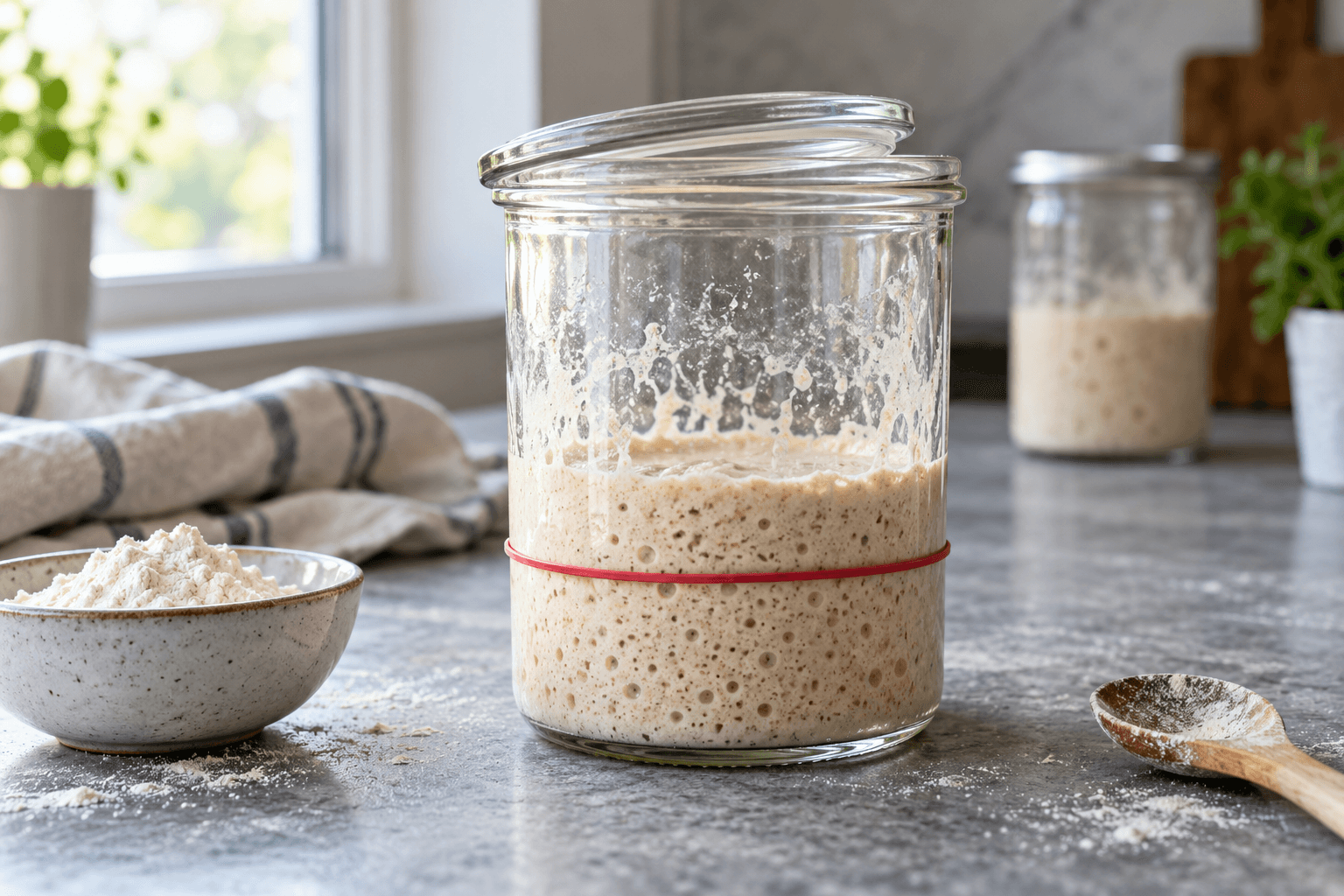
For your next observation, use a clean, straight-sided food-safe container with room for expansion. After feeding and mixing, mark the starting level with a rubber band and note the time. Cover according to your starter method, allowing gas to escape rather than sealing it airtight. Check at a few sensible intervals. A photograph from the same angle can help if you are away for part of the day.
King Arthur's feeding-ratio trials show why timing matters: starters with different amounts of fresh food reached their peaks at different times. You do not need to reproduce those trials. The useful lesson is that a jar checked after work can tell a different story from the same jar checked at lunchtime.
2. Is it a young starter in a quiet stage?
A new starter is not a mature culture with an inconvenient personality. King Arthur's not-rising guide notes that an initial burst can be followed by a quiet period lasting a week or more. That can happen even when you keep feeding consistently. An impressive first rise is not, by itself, proof that the starter is ready to raise bread reliably.
Return to the starter recipe you are following and keep its amounts and maintenance schedule consistent. Do not turn 'give it time' into a promise that every jar will be ready on a particular day. The better milestone is repeated, dependable activity after feeding under conditions you can reproduce.
If your starter is still developing, give your weekend bread plan another option instead of forcing the jar to meet a calendar. You can enjoy a different baking recipe while the culture becomes established. Beginning again every time the third or fourth day looks quiet can keep you repeating the same uncertainty.
3. Is the jar colder than your recipe assumes?
A counter near a drafty window can have a different working temperature from the room you find comfortable. Check the actual area with a thermometer if possible. In King Arthur's troubleshooting guidance, temperatures below 68°F slow fermentation considerably compared with a warm room. Around 75°F is a useful warm-room reference, not a deadline guarantee or a requirement to buy a heated device.
Our practical starting choice is a stable spot away from drafts and direct heat. Do not put the jar against a radiator or into a warming oven you cannot accurately control. A location that feels gently warm now can become much hotter later. Stabilizing one ordinary place is easier to understand than repeatedly moving the starter around the kitchen.
Record the temperature with the next feeding time if you are comparing cycles. If the same recipe behaves differently on a cooler evening, that observation is useful. It is not evidence that your kitchen has suddenly lost the ability to make bread.
4. Are you feeding by weight, with a consistent ratio?
Equal spoonfuls are not the same as equal weights. The ratio 1:1:1 means starter, flour and water in equal amounts by weight; for example, 20 g of each makes 60 g total. That small arithmetic example illustrates the notation, not a complete from-scratch starter schedule. Use the proportions and timing appropriate to the method you chose.
Notice the retained starter as well as what you add. Keeping an increasingly large jar and adding the same small spoon of flour each day does not maintain the original ratio. Conversely, frequently replacing a weak young mixture before the recipe calls for it does not give you a clear feeding cycle to observe. Consistency makes the response easier to interpret.
Higher feeding ratios can shift the time to peak; they are not automatically a stronger dose of help. If you change both ratio and temperature, a later rise will be difficult to explain. We would correct a measuring misunderstanding first, then watch a cycle before introducing another change.
5. Is it too thin to show the rise you expect?
Bubbles and height are related but not identical observations. King Arthur's beginner tips explain that a very thin starter may let gas escape without expanding much. A liquid-looking mixture can make a large rise difficult to see even when bubbles appear. That does not mean every bubbling jar is ready to leaven a loaf.
Check whether an accidental volume-for-weight substitution added too much water. Think about flour changes as well: a different flour can change the consistency, so compare the jar with the same recipe and ingredients before judging your care. Do not keep throwing in unmeasured flour until the texture resembles an internet photograph.
If your measurements are already consistent but activity remains weak, a small whole-grain component is an option described in the manufacturer's troubleshooting guide. Treat it as one deliberate change within that guidance, not a reason to replace every ingredient at once. Keep enough notes to know what helped.
What to do at the next feeding
Choose the most likely explanation and change one thing. If you may have missed the peak, mark the jar and observe. If it is young, follow its recipe through the quiet stage. If the spot is cold, choose a stable warmer one. If the ratio is unclear, weigh it. If it is unexpectedly thin, check the measuring method before changing flour.
For deciding when to bake, use repeated rise and the readiness signs in your chosen recipe. Do not let one floating spoonful overrule the rest of the evidence: King Arthur's float-test discussion shows why flotation alone is not a reliable readiness test.
If you like making one small change and tasting the result later, our guide to repeating a recipe develops that pleasure. For another kitchen hobby where variables can be separated, try our first French press guide.
Hobby-ist's recommendation is to rescue a clear process before shopping for a new starter. A marked level, a measured feeding and a stable place often tell you more than another worried scroll. The satisfying moment is not merely seeing the jar rise. It is understanding enough of the pattern to know why you are keeping it.
Baking references checked October 14, 2026. Follow the recipe and food-handling instructions you use; suggested observations are not guarantees of recovery.
Sources & verification
Information checked: 2026-10-14
- https://www.kingarthurbaking.com/blog/2024/12/19/why-is-my-sourdough-starter-not-rising
- https://www.kingarthurbaking.com/recipes/sourdough-starter-recipe
- https://www.kingarthurbaking.com/blog/2025/03/13/sourdough-feeding-ratios
- https://www.kingarthurbaking.com/blog/2020/06/10/10-tips-for-new-sourdough-bakers
- https://www.kingarthurbaking.com/learn/guides/sourdough/faq
- https://www.kingarthurbaking.com/blog/2019/01/02/the-float-test-for-yeast-dough-and-sourdough-starter