Getting Started
Your First Instant Photos: Get Closer to the Picture You Wanted
A bright face in a dark room or a tiny subject on a white-bordered print can be disappointing. Learn distance, background and film handling before spending the next frame.
By Hobby-ist Editorial Team · 5 min read · October 15, 2026
In this story
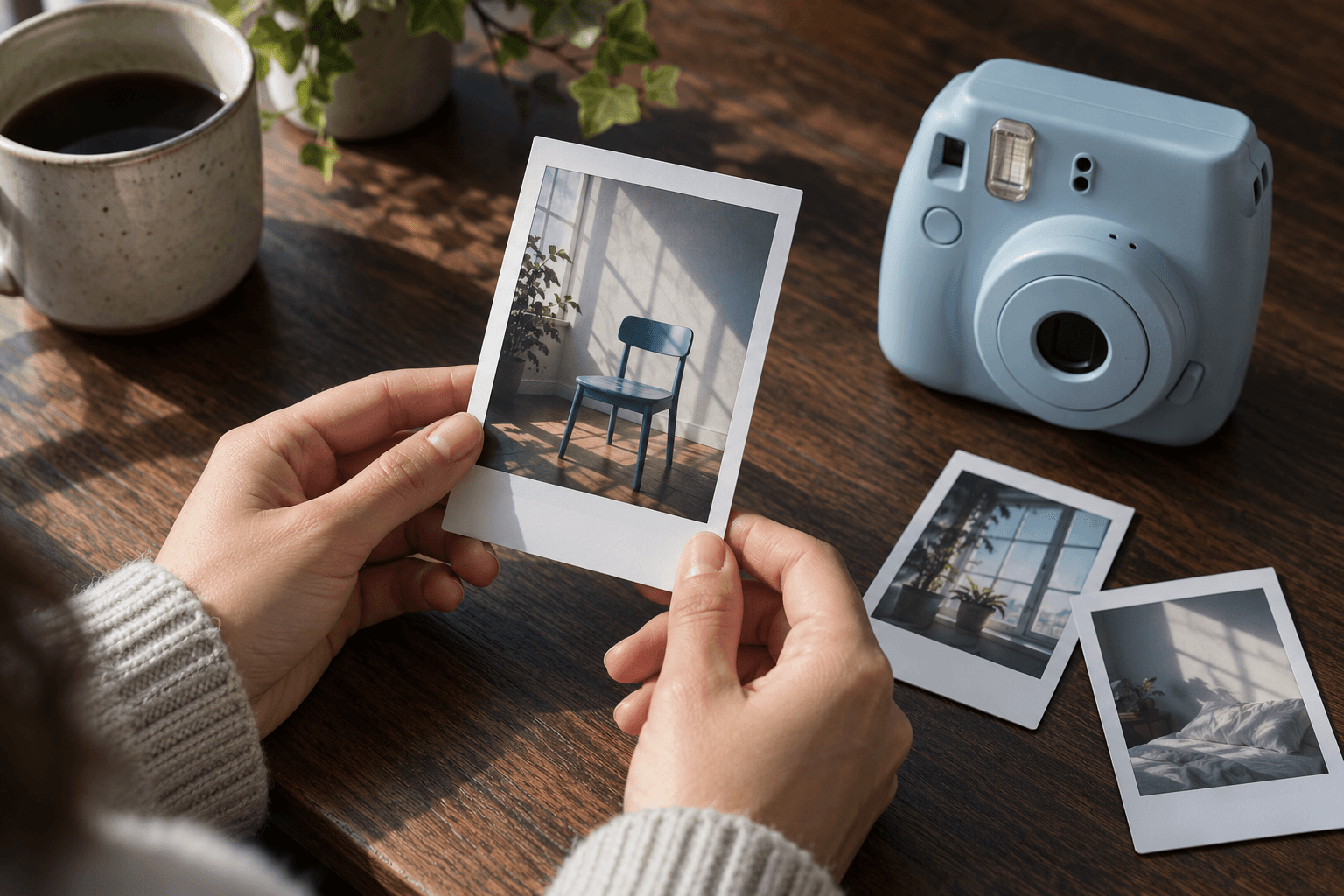
A photograph can feel completely different when it fits in your palm. On a phone, you can zoom in until the subject fills the screen. On a small instant print, a friend at the far end of a room may remain a very small friend forever. The white border cannot rescue a composition that asked a tiny image to hold too much.
That constraint is part of the pleasure. Instant photography gives you an object to pass across a table, with fewer chances to hide an indecisive frame in a thousand-image gallery. A good first aim is not a nostalgic look at any cost. It is a print whose subject still matters when you hold it at normal reading distance.
Begin with one clear subject
Choose a simple first scene in decent light: one person, one object, or a small arrangement whose shape you like. Before pressing the shutter, look at the edges. Is a bright window more prominent than the face? Does a table leg seem to grow from the subject? A small step sideways can remove a distraction without asking the camera to solve it.
Get closer within your model's permitted focusing distance rather than relying on later cropping. With a print, cropping changes the physical object or requires a separate scan; it is not the effortless gesture of enlarging a phone image. Keep the background useful but quieter than the subject. A room can provide context without including every chair in it.
For a suggested three-picture beginning, photograph a simple object, a willing friend and one detail of a familiar place. They do not have to be made in one sitting. The point is to notice which kind of small picture you enjoy keeping, not to spend a whole pack proving you understand the camera.
Distance has a mechanical answer
Use your camera's manual rather than treating all instant cameras as interchangeable. As a concrete example, the Fujifilm instax mini 12 guide specifies normal shooting from at least 0.5 m and close-up mode for 0.3–0.5 m. It lists an effective flash range of approximately 2.2 m. Those are model-specific limits, not instructions for every instant camera.
That example helps explain a familiar disappointment: a flash can illuminate a nearby person without lighting an entire dark room. A distant background may remain dark even when the face is bright. Rather than assuming the film is faulty, try a simpler scene with more surrounding light and an appropriate subject distance. Keep fingers and straps clear of the lens, flash and sensors.
If a close subject is soft, check whether it was closer than the permitted range or needed a close-up setting. If the subject is sharp but the frame feels wrong, the problem may be composition rather than focus. Separating those questions stops you from changing film or blaming the camera for a decision made before the shutter.
A used frame can tell you something
When a print disappoints, wait for development as the film instructions specify before deciding what happened. Then name one feature: too much background, distracting bright area, subject too small, or camera movement. Keep the next attempt close enough to the first that a change has a meaning. Moving to a different room with a different subject and different light makes a useful comparison harder.
You do not need to stage a demonstration of failures. Just keep a print that reminds you what to notice next time. A short note on a separate card can be useful if you want one; you do not have to turn every picture into a worksheet. Sometimes the imperfect print is also the one your friend wants to take home.
Respect that choice. Ask before photographing people, and ask before sharing the picture online. An instant object can feel private even if you are accustomed to treating phone photographs as ready-to-post material. Giving someone the print can be the completion of the experience.
Protect the next picture before it exists
Do not open a loaded camera back to check how much film remains. Use the counter and the instructions for your model. Fujifilm warns that opening a loaded mini 12 can expose unused film. Its manual also advises protecting film from heat and avoiding cutting, piercing or peeling instant film. Keep the pack and camera out of a hot parked car and follow the package's handling directions.
Use the manufacturer's support page to find the correct manual if your camera differs from this example. Film formats are not interchangeable just because packages look similar. Check the exact compatible format before buying a multipack, along with the expiration date and your storage plan. Cost per usable picture matters more than the advertised price per sheet if the wrong film sits unused.
Choose the delay you enjoy
If you want to hold and share a picture during an outing, instant film offers a different pleasure from our first 35mm roll guide, which includes the later step of lab processing. Neither is a more authentic way to enjoy photography. Choose the workflow whose waiting and results appeal to you.
For looking at what makes one picture worth keeping, read Six Photos, One Choice. The same attention applies to a small physical print.
Hobby-ist's judgment: begin with a simple, well-lit subject and a distance your camera can handle. The reward is a picture you want to pass to someone, not a pack emptied in pursuit of a perfect first shot.
Camera handling references checked October 14, 2026. Follow the manual and film packaging for your exact equipment.
Sources & verification
Information checked: 2026-10-14