Getting Started
Your First Roll of 35mm Film: Spend It on an Ordinary Day
You do not need a perfect trip to begin film photography. One working camera, one roll and a repeatable neighborhood walk can teach you more than chasing a nostalgic look.
By Hobby-ist Editorial Team · 5 min read · October 10, 2026
In this story
A film camera makes a small promise: you will find out later. That can sound romantic until the first roll is in your hands and every frame feels too expensive to spend on an ordinary afternoon. You wait for a better trip, a better sunset, a person who knows how to pose. The camera becomes a beautiful object that never quite starts being a hobby.
We would spend the first roll on a place you can visit again. A familiar block, a weekend market viewed from public space, the light beside your own window. Repeatability gives you something a once-in-a-lifetime scene cannot: another chance to understand what happened. The goal of this roll is not to prove that film looks better. It is to discover whether you enjoy the slower chain of decisions.
Start with a working camera, not a famous name
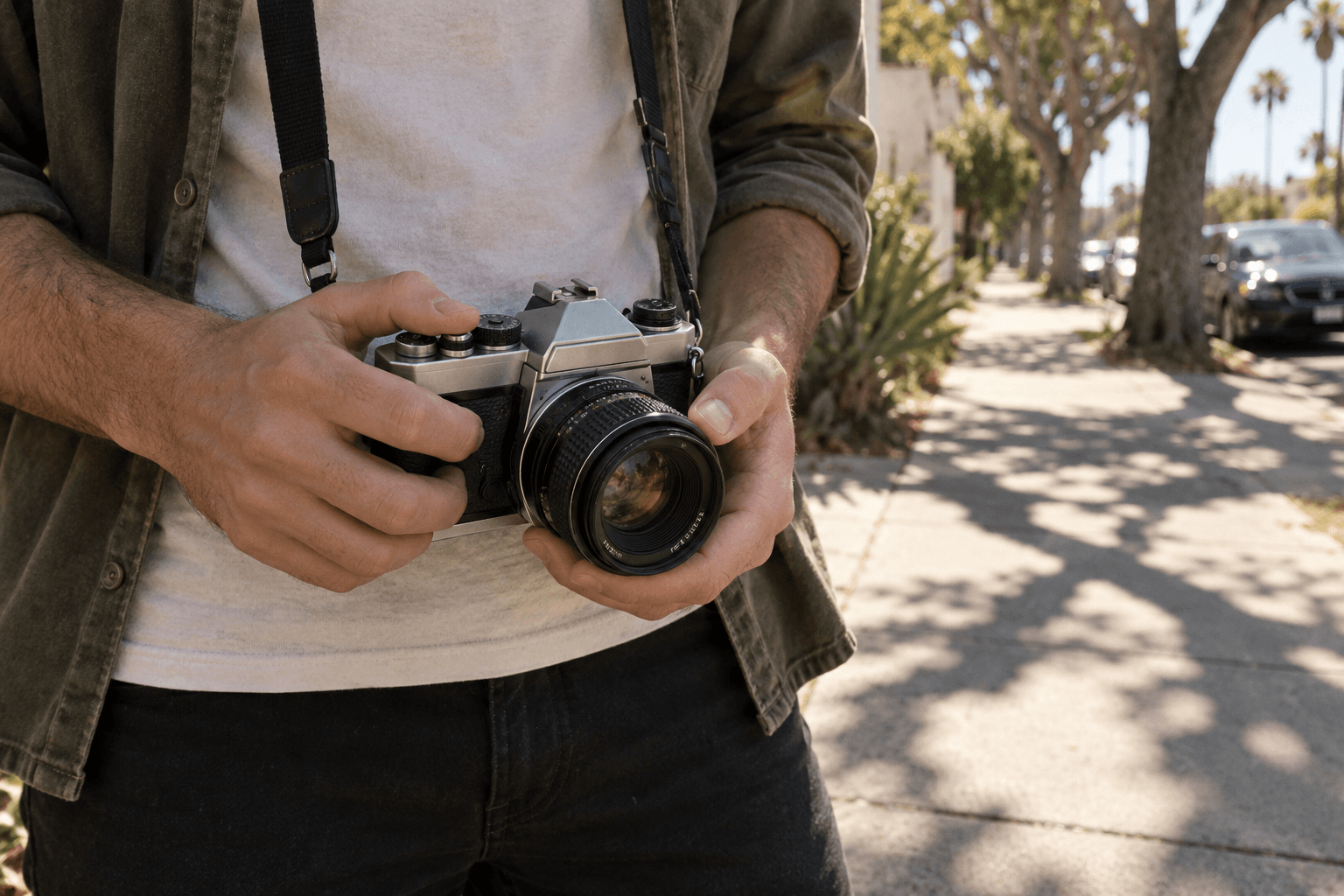
Borrowing a known-working 35mm camera is our preferred first experiment. If buying used, ask what was tested, whether there is a recent sample roll, and what the return policy covers. Confirm the battery type, meter operation if present, lens controls, film advance and rewind procedure. “The shutter clicks” is a limited check, not proof that the camera exposes or transports film correctly.
Read the manual for your specific model before loading. Some cameras advance and rewind automatically; others need a particular release and manual sequence. Avoid copying a generic video as if every camera works the same way. Ask a camera shop to demonstrate loading if you are uncertain. The best first camera is one whose basic operation you can explain back to yourself.
A point-and-shoot can suit someone who wants to notice scenes with fewer controls. A manual SLR can suit someone curious about focus and exposure. We would not force the second choice on a person whose real interest is walking and looking. Learning the equipment and learning to see are connected, but they do not have to arrive in the same-sized dose.
Choose one roll for the light you actually have
Film format and speed are different decisions. A 35mm camera needs compatible 35mm film, not a 120 roll simply because the packaging is attractive. ILFORD’s first-film guide explains that ISO describes light sensitivity: a higher number is more useful when light is limited, while slower films generally offer finer grain at their recommended rating.
For a simple daylight walk, a fresh color-negative roll around ISO 200 or 400 is an approachable starting point, provided your camera supports it. That is our planning suggestion, not a universal best film. If black and white is what excites you, HP5 PLUS is an ISO 400 example that ILFORD describes as having broad exposure latitude. Choose a film you can afford to process again.
Do not begin by chasing an expired-film surprise unless the uncertainty is the point. Fresh film keeps one variable simpler. On a manual-ISO camera, match the setting to the box speed for this first experiment; on an automatic camera, check how it reads or sets ISO. Changing a dial halfway through a roll does not change the film itself.
Ask the lab before you press the shutter
Find out whether your lab processes that exact film, what development and basic scans cost together, how you receive the files, how long it usually takes, and how the negatives are returned. The ongoing cost is a roll plus processing and your chosen output—not just the price of the camera.
Processing types matter. Kodak’s GOLD 200 technical sheet specifies C-41 for that color-negative film. Conventional black-and-white film such as HP5 uses a different process; ILFORD’s XP2 is a black-and-white exception intended for C-41. Tell the lab the exact film name rather than saying only “black and white.”
We would buy modest scans first if the immediate purpose is learning and sharing on a screen. Ask what the lab’s scan options actually include rather than assuming the most expensive level will rescue a poor exposure. Keep the negatives: a file is the current output, while the original frames may be useful for rescanning later.
A first-roll walk that leaves something to compare
Choose one familiar subject in good light and give it several frames: one wider view, one closer detail, and one after moving your position. This is our exercise, not a rule about how much film a scene deserves. Comparing related images helps you see the consequence of a decision. A roll of unrelated lucky moments can be beautiful but harder to learn from.
Add a few notes on your phone or paper: frame number, light, and what you tried. If using manual controls, note the exposure settings where practical. Keep it brief enough that taking notes does not consume the walk. Ask permission before photographing a person closely, and respect the place’s photography rules.
Do not make your first roll the only record of an important celebration. Let the stakes stay low. An ordinary doorway or tree shadow gives you permission to be imperfect; an unrepeatable family moment may put pressure on unfamiliar equipment.
Finish the roll carefully, then read the results
If the advance reaches its limit or feels resistant, stop rather than forcing it. Follow the model’s rewind instructions and confirm rewinding has completed before opening the back. Do not open the camera to check whether pictures are there; exposed film needs processing before it can be viewed normally. If you are unsure or the mechanism jams, take the closed camera to a shop.
When scans arrive, pick three frames: one you love, one that almost works, and one you do not understand. Compare them with your notes. A blurry subject, an unexpectedly dark frame and an empty frame suggest different questions; not every surprise is a desirable “film look.” Ask the lab or a technician for help if a whole roll shows a repeating problem.
Then change one thing on the next roll. Keep the camera and film familiar while working on steadier holding, a brighter time of day or a more deliberate distance. Our six-photo exercise develops that habit of choosing; the one-color photo walk offers a small subject to take outside.
Hobby-ist’s judgment: film is a good first experiment for someone who enjoys decisions, anticipation and recurring costs they can manage. If immediate feedback is what keeps you curious, begin the same walking exercise on your phone. Either way, the ordinary afternoon is already enough to start.
Technical references checked October 9, 2026. Camera operation always depends on the model’s own instructions.
Sources & verification
Information checked: 2026-10-09