Perspectives
Do You Have to Be Good at Your Hobby?
A hobby can include ambition without becoming another test you have to pass. Make room for practice, private enjoyment, and the choice to continue on your own terms.
By Hobby-ist Editorial Team · 6 min read · September 27, 2026
In this story
Someone asks to see what you have been making. You reach for your phone, then immediately begin explaining. You have only just started. The light was bad. The shape is supposed to be uneven, although perhaps not quite that uneven.
Before the other person has said anything, you have already delivered the review.
It is a familiar possibility when we bring a private pleasure into public view: the activity we enjoyed doing becomes a result we feel obliged to defend. An afternoon spent making something shrinks to the question of whether the thing looks good.
But what if you liked the afternoon?
That seems like a small detail until you consider how many parts of adult life already ask for evidence that your time was well spent. A hobby can make room for a different answer.
The result is only part of what happened
Think of a beginner trying to draw a mug. The handle is too large. The opening at the top tilts in a direction the real mug does not. Viewed only as a drawing, it may not be what they hoped to make.
During those twenty minutes, though, they noticed that the handle casts a second, smaller shadow. They tried holding the pencil farther back. They became curious about the difference between looking at an object and drawing the idea of it.
None of that corrects the proportions. It does mean the session contained more than a disappointing picture.
There are several things we might want from a hobby: a satisfying result, a new skill, an absorbing process, a reason to spend time with someone. They do not always arrive together. One can be present while another takes longer.
Before declaring the session a failure, it is worth asking which of those things brought you to the table in the first place.
Wanting to improve is allowed, too
There is another trap in telling ourselves that hobbies should be relaxing: we can start feeling that ambition is somehow doing leisure incorrectly.
You might love a training plan. You might enjoy repeating a musical phrase until it changes, or learning exactly why a seam will not sit flat. For some people, progress is part of the pleasure. There is nothing to apologize for there.
The useful distinction is between choosing a challenge and believing you must earn the right to continue. “I want to learn to draw this handle” offers a next step. “I should stop drawing if I cannot do this well” closes the whole activity around one difficulty.
A hobby can have standards without making every session a verdict on whether you belong.
Try choosing one small thing to practice while leaving the rest of the session open. Work on the handle for ten minutes, then draw something else simply because you want to. The entire afternoon does not have to carry the same assignment.
Decide who the work is for before you show it
An audience can be helpful. A thoughtful teacher may see the one adjustment you cannot identify. A friend may share your delight in a small improvement. A group may make returning next week easier.
An audience also changes the question. Something made to explore a color can become something made to photograph convincingly. A walk can start revolving around whether it produced a picture worth posting.
Neither sharing nor keeping things private is inherently better. The point is to choose, rather than let an imagined audience sit beside you from the first minute.
You could give one session a simple boundary: nothing from today has to be posted. Or decide in advance what kind of response would help: “I’m excited about the colors; I’m not looking for a full critique yet.”
If you do want feedback, make the question specific. “Which of these two compositions reads more clearly?” gives someone a useful way to respond. “Am I any good?” asks them to judge far more than a single piece of work.
Borrow one detail from the person you admire
It is easy to open a tutorial for instruction and leave with an unfavorable comparison. The person on screen works quickly, owns the right tools, and seems to know what every step will look like before it happens.
You do not have to stop looking at work you admire. Try giving the comparison a narrower job.
Choose one detail you can investigate: the way a photographer frames a doorway, how a knitter organizes a project, where a painter leaves an area untouched. Ask what you could try with your present materials and time.
If the answer is “nothing yet,” save the example for later. Admiration does not always need to become an assignment immediately.
The same approach works in a class. Someone beside you may have much more experience. Instead of treating their finished piece as the standard for your first attempt, ask about one move you watched them make. Curiosity is a more useful companion than an invisible ranking.
Keep a record that includes enjoyment
A record of results is easy to build: photographs, finished objects, distances, completed pages. Consider adding a quieter record beside it.
After a few sessions, write one sentence answering one of these questions:
- Which part made me want to stay a little longer?
- What became slightly less unfamiliar?
- What would I like to try again, even if nobody saw the result?
“I liked choosing the thread” may reveal a different interest from “I liked finishing the pattern.” “I wanted more time talking with the group” says something that a photograph of the finished work cannot.
These answers do not replace technical feedback when you want to improve. They help you remember why improvement matters to you, and whether the activity is giving you anything you actually want.
You are also allowed to stop
Permission to be an amateur should not become an instruction to persist forever. You may dislike the activity, the setting, the expense, or the amount of preparation it requires. You may simply be interested in something else now.
Try distinguishing embarrassment from lack of interest. If nobody would see the result, would you want another hour with the activity? If the answer is yes, a smaller or more private version may be worth trying. If the answer is no, you do not need to prove your character by continuing.
Our guide to choosing a hobby treats a first attempt as an experiment. That idea still applies after several attempts. You are gathering information about what fits your life, not signing a contract with a new identity.
Let the next session be a session
In Something to Look Forward To, we wrote about the value of having a time you want to return to. That time does not have to become more impressive each week to remain worth keeping.
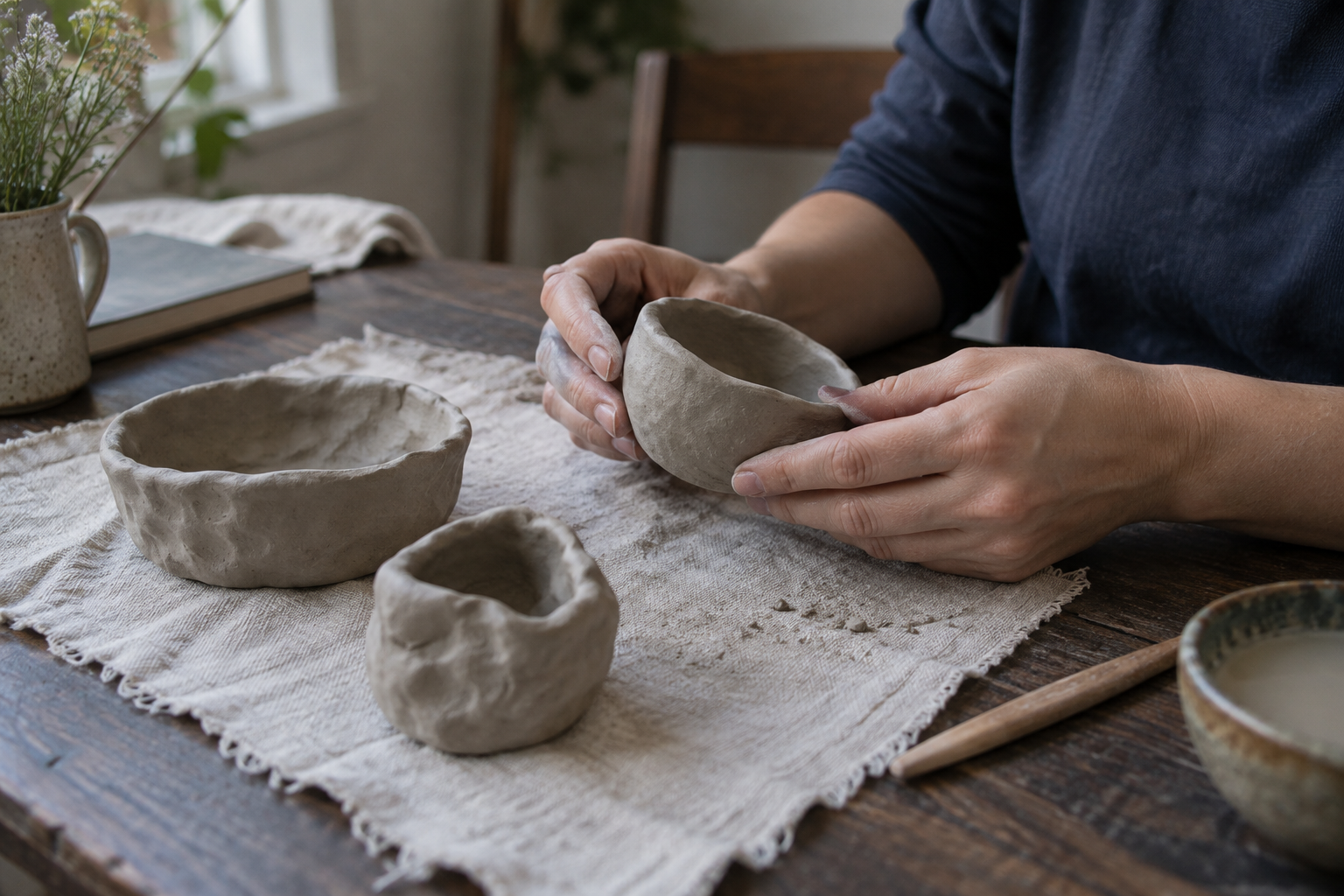
Perhaps your next bowl will be rounder. Perhaps it will not. Perhaps you will discover that you like working with your hands while someone tells you about their day.
You can take the craft seriously and let that be part of the answer, too. When someone asks how it went, you do not always have to begin with an apology for what you made.
You can say: I enjoyed making it. I think I will go again.
Sources & verification
Information checked: 2026-09-27